



 +31 20 820 3777
 Compliance
  Support
  Documentation
 Login
Login 




Hosting customers generally fall into two categories. Some arrive with a complete technical specification, knowing exactly which processor they need and why. Others are just starting out and look at the product catalog with a sense of confusion. This second group often asks the same question: Why does a configuration with similar RAM, storage, and networking differ in price by approximately $65 (based on June 2026 pricing) when the only visible difference is the CPU?
For instance, let's look at an example from our lineup. A Ryzen 9950X—with 16 cores, a manufacturer-rated boost clock of up to 5.7 GHz, and a TDP of 170W—costs roughly $220 per month ($2,640 per year). In comparison, an EPYC 9354 with 32 cores, a boost clock of up to 3.8 GHz, and a TDP of 280W costs about $285 per month ($3,420 per year). The Ryzen offers nearly 1.5x higher clock speeds at a lower price point. The EPYC provides double the cores and an enterprise server architecture. Looking at a spec sheet alone won't tell you which is "faster," as the answer depends entirely on your specific workloads.
We wanted to move beyond the theoretical argument that "EPYC is better for servers because it’s a server CPU." We wanted hard data from both machines under identical conditions. We ran both nodes through the same suite of 25 tests, including CPU synthetics, OpenSSL, STREAM (memory bandwidth), fio (disk I/O), pgbench, Redis, nginx, a multi-tenant scenario with ten parallel workloads, and a 30-minute thermal stress test. Below, we break down where Ryzen takes the lead, where it falls behind, and in which scenarios the price premium for EPYC actually pays off.
Test Bench Configurations
Before diving into the results, let's establish exactly what is being compared. We are testing two servers with different architectures; most of the differences observed in the following tests stem from the hardware specifications detailed below.
|
Parameter |
EPYC 9354 |
Ryzen 9950X |
|---|---|---|
|
Architecture |
Zen 4 (Server) |
Zen 5 (Desktop) |
|
Cores / Threads |
32 / 64 |
16 / 32 |
|
Base Clock |
3.25 GHz |
4.3 GHz |
|
Boost Clock |
Up to 3.8 GHz |
Up to 5.3 GHz |
|
TDP |
280W |
170W |
|
L3 Cache |
256 MB |
64 MB |
|
Memory Channels |
12-channel DDR5 |
2-channel DDR5 |
|
RAM (Our Config) |
192 GB |
128 GB |
|
PCIe Lanes |
128 Gen 5 lanes |
28 Gen 5 lanes |
|
ECC Memory |
✓ Required |
✗ Not supported |
|
IPMI / BMC |
✓ Available |
✗ Not available |
|
RAS Features |
✓ Full Suite |
✗ Consumer-grade |
|
Network Speed |
10 Gbps |
1 Gbps |
The first few rows make the test outcomes predictable. The Ryzen 9950X uses the newer Zen 5 microarchitecture with higher IPC (Instructions Per Clock) and clock speeds, giving it an edge in single-threaded tasks. In multi-threaded scenarios, core count is king—and here we have 32 cores versus 16. Where memory bandwidth is the bottleneck, the 12 DDR5 channels on the EPYC will heavily outweigh the Ryzen's 2 channels.
Disk subsystems were not part of this comparison. The two test benches used NVMe drives of different capacities and generations, making fio results between the machines incomparable. All data in this article refers strictly to CPU and memory performance.
On the Ryzen 9950X bench, Simultaneous Multithreading (SMT) is unavailable at the platform level. The processor controller returns a "not supported" status, meaning the CPU operates with 16 threads on 16 cores. This isn't a temporary test setting; it is the standard configuration as delivered to customers. Our service terms prohibit BIOS modifications, so all tenants will experience this same setup. On the EPYC, SMT is enabled, providing 64 threads across 32 cores. Keep this in mind when reading the multi-threaded results below: the Ryzen figures represent the actual performance a real customer would receive, not a theoretical laboratory maximum.
Where Ryzen Wins and Why
There are specific scenarios where the Ryzen 9950X outperforms the EPYC 9354. Let's examine which tests showed this advantage and how those results translate to production workloads.
Single-Threaded Performance
The single-threaded sysbench test measures how quickly a single core can execute a set of operations without interference, memory contention, or locking.
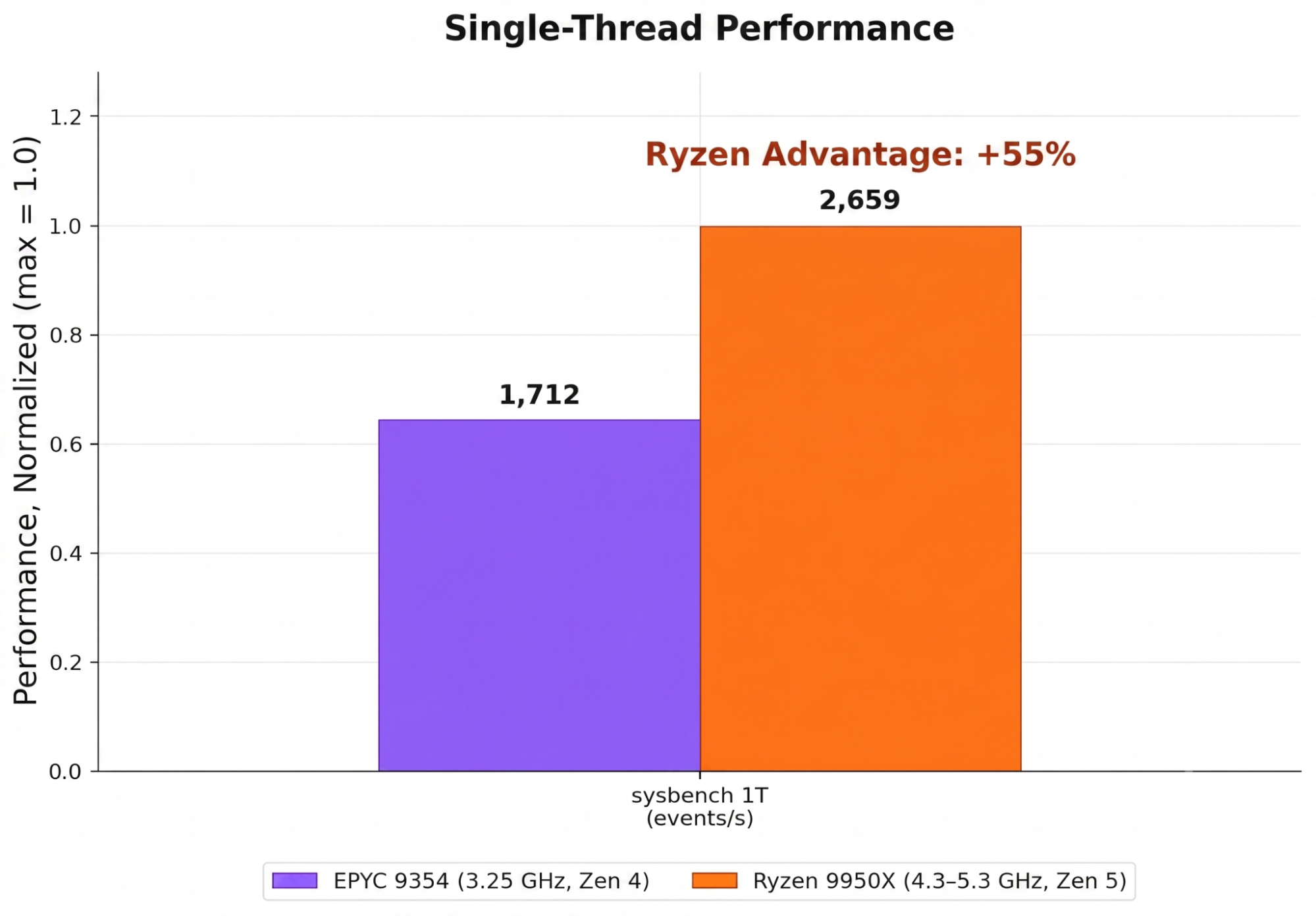
Ryzen leads EPYC by approximately 55% in this metric. This is due to the combination of higher clock speeds and architectural generational gains. The Ryzen 9950X has a base clock of 4.3 GHz compared to the EPYC's 3.25 GHz, compounded by the Zen 5 architecture's significantly improved IPC over Zen 4.
In practice, this difference is felt in any task where a single thread becomes the bottleneck. Common examples include Node.js applications before processes are clustered, Bash scripts, unparallelized Python data processing, and compiling small modules where there is no opportunity for parallelism. In these scenarios, a 55% performance gap is highly noticeable.
nginx and Redis: CPU Limits Without Network Constraints
The figures below require a brief disclaimer: they represent the theoretical maximum of the processor under ideal conditions without physical network overhead. Real-world production environments will look different (more on that later), but we want to establish these baseline absolute values first.
|
Metric |
EPYC 9354 |
Ryzen 9950X |
|---|---|---|
|
nginx @ 1000 connections, Requests Per Second (RPS) |
823,000 |
1,420,000 |
|
Redis SET, Operations Per Second (ops/s) |
1,120,000 |
3,850,000 |
|
Redis GET, Operations Per Second |
1,130,000 |
4,460,000 |
Ryzen outperformed EPYC by about 72% on the nginx web server, nearly 3x for Redis SET operations, and nearly 4x for Redis GET operations. While impressive, it is critical to understand what these numbers actually measure.
Both tests were conducted via loopback (127.0.0.1), meaning the client and server reside on the same host. The traffic never leaves the virtual interface into the physical network stack. This measures the "ceiling" of the application and the CPU itself—how fast nginx or Redis can process requests when there is zero network latency.
In production, the picture changes. Real-world Redis and nginx instances serve clients over a network. Our Ryzen 9950X configuration comes with a 1 Gbps link, whereas the EPYC 9354 features a 10 Gbps link. To put that in perspective, 1 Gbps provides roughly 125 MB/s of bandwidth—and once you subtract TCP/HTTP overhead and request headers, your actual throughput is significantly lower.
Response size becomes the deciding factor here. With tiny 100-byte responses, Ryzen can approach loopback performance because a 1 Gbps link can handle a massive number of such small packets. However, with typical HTTP responses (1–10 KB), the network will hit its ceiling at roughly 12,000 to 125,000 RPS. At that point, Ryzen hits a network bottleneck long before it hits a CPU bottleneck. The EPYC's network ceiling is ten times higher.
This doesn't mean loopback figures are useless; they show the raw capability of the CPU for that specific task. If you were to upgrade the Ryzen machine to 10 Gbps, its CPU ceiling would remain the same—the loopback numbers simply answer "how much can the processor squeeze out" rather than "how many requests will actually reach my clients."
The takeaway: Single-threaded tasks and non-network-bound tests are clearly where Ryzen shines. The rest of this article focuses on scenarios where the advantage shifts: multi-threaded workloads, memory bandwidth bottlenecks, and sustained high-temperature operation.
Where EPYC Takes the Lead
Now, let's look at the benchmarks where the results flip. (Note: As a reminder, SMT is disabled on our Ryzen test bench, providing 16 threads/16 cores, while EPYC runs with full 64-thread support).
Memory Bandwidth: The STREAM Test
This is the most significant gap in the entire suite. The STREAMbenchmark measures how quickly the CPU and memory subsystem can move data. This isn't just "synthetic for the sake of synthetic"; it correlates directly to any workload that is memory-bound.
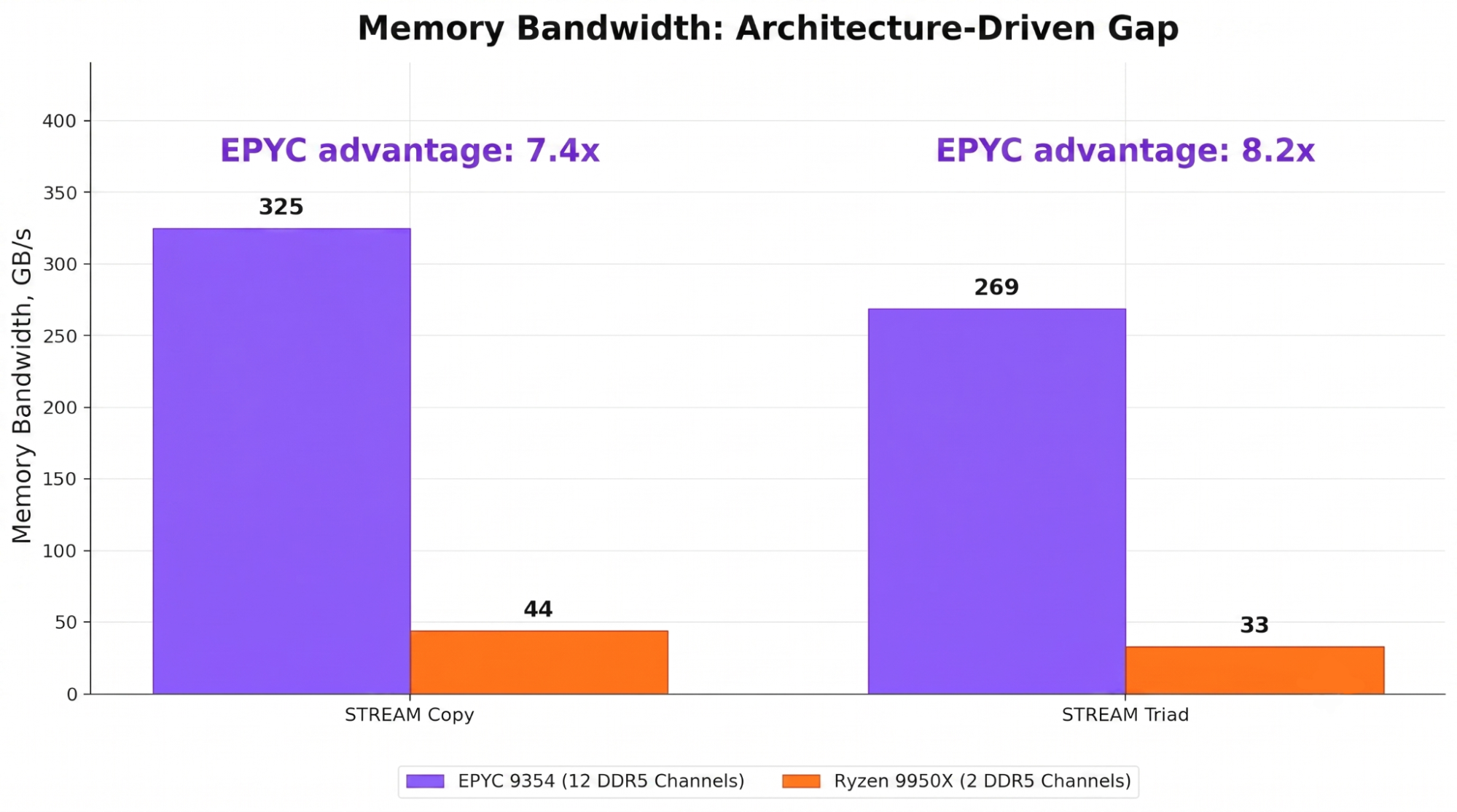
The performance gap here is roughly 7–8x. This isn't due to software or firmware settings, but fundamental architecture. The EPYC 9354 features 12 DDR5 memory channels, while the Ryzen 9950X has only 2. You are essentially comparing six lanes of traffic against one on each side. This cannot be optimized away by drivers or the kernel because it is a physical hardware difference between a motherboard designed for twelve DIMM slots and one designed for four.
In practice, this means any workload where data exceeds the CPU cache and must constantly move between cores and RAM will run significantly faster on EPYC. Typical examples include in-memory databases (Redis or Memcached) with large datasets, analytical queries involving massive amounts of data, ML model inference on the CPU, and any applications optimized for NUMA architectures.
In our earlier nginx/Redis loopback tests, Ryzen was much faster because those tests utilized tiny keys that fit entirely within the L3 cache. As soon as your dataset exceeds the L3 cache—which is 256 MB on EPYC versus only 64 MB on Ryzen—the bottleneck shifts from CPU frequency to memory bandwidth, and the advantage flips completely.
Multi-threaded Workloads
The results here are expected. When tasks are parallelized across cores, EPYC's 32 physical cores provide a clear advantage over Ryzen's 16.
|
Test |
EPYC 9354 |
Ryzen 9950X |
Difference |
|---|---|---|---|
|
sysbench multi-thread, events per second (eps) |
58,822 |
38,875 |
+51% |
|
7-Zip compress, MIPS |
241,806 |
116,325 |
+108% |
|
7-Zip decompress, MIPS |
255,339 |
88,749 |
+188% |
|
OpenSSL AES-256-GCM, GB/s |
140 |
99 |
+41% |
|
OpenSSL SHA-256, GB/s |
109 |
40 |
+173% |
|
RSA-2048 verify, ops/s |
2,167,000 |
1,485,000 |
+46% |
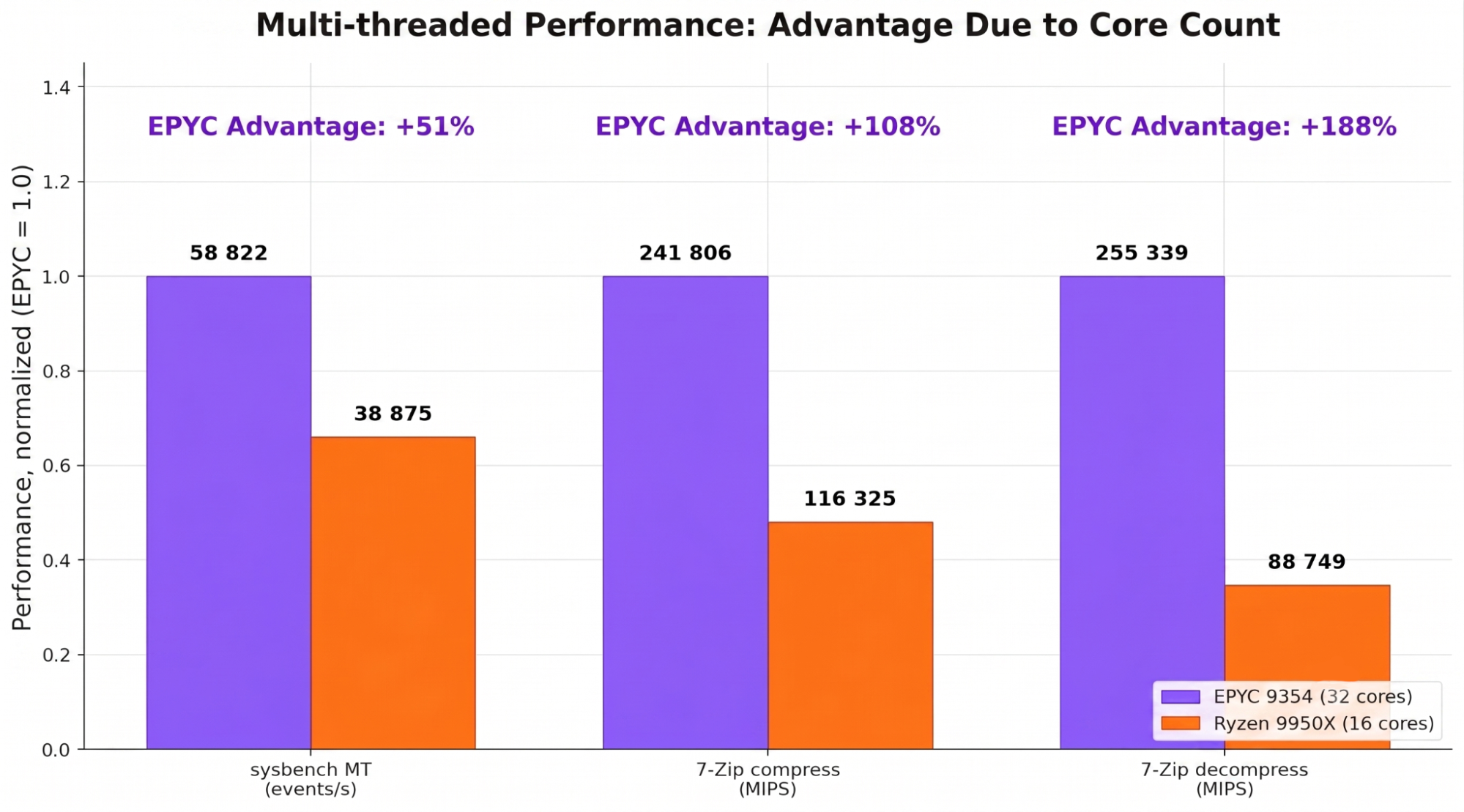
This is where the lack of SMT on the Ryzen bench becomes critical. Because we cannot enable hyperthreading on our Ryzen servers due to service terms, these numbers represent exactly what a customer will experience in production. The EPYC's lead isn't a "theoretical maximum"; it's the actual performance gap a customer will work with.
The OpenSSL SHA-256 result is particularly striking: EPYC outperforms Ryzen by 173%. This massive gap—even considering the core count difference—is due to specialized hardware instructions (SHA-NI). Since EPYC has twice as many cores, it has twice the capacity to execute these single-cycle instructions. On AES-GCM, a similar instruction set (AES-NI) exists on both, but the gap is smaller (+41%) because that workload leans more toward clock speed than raw core count.
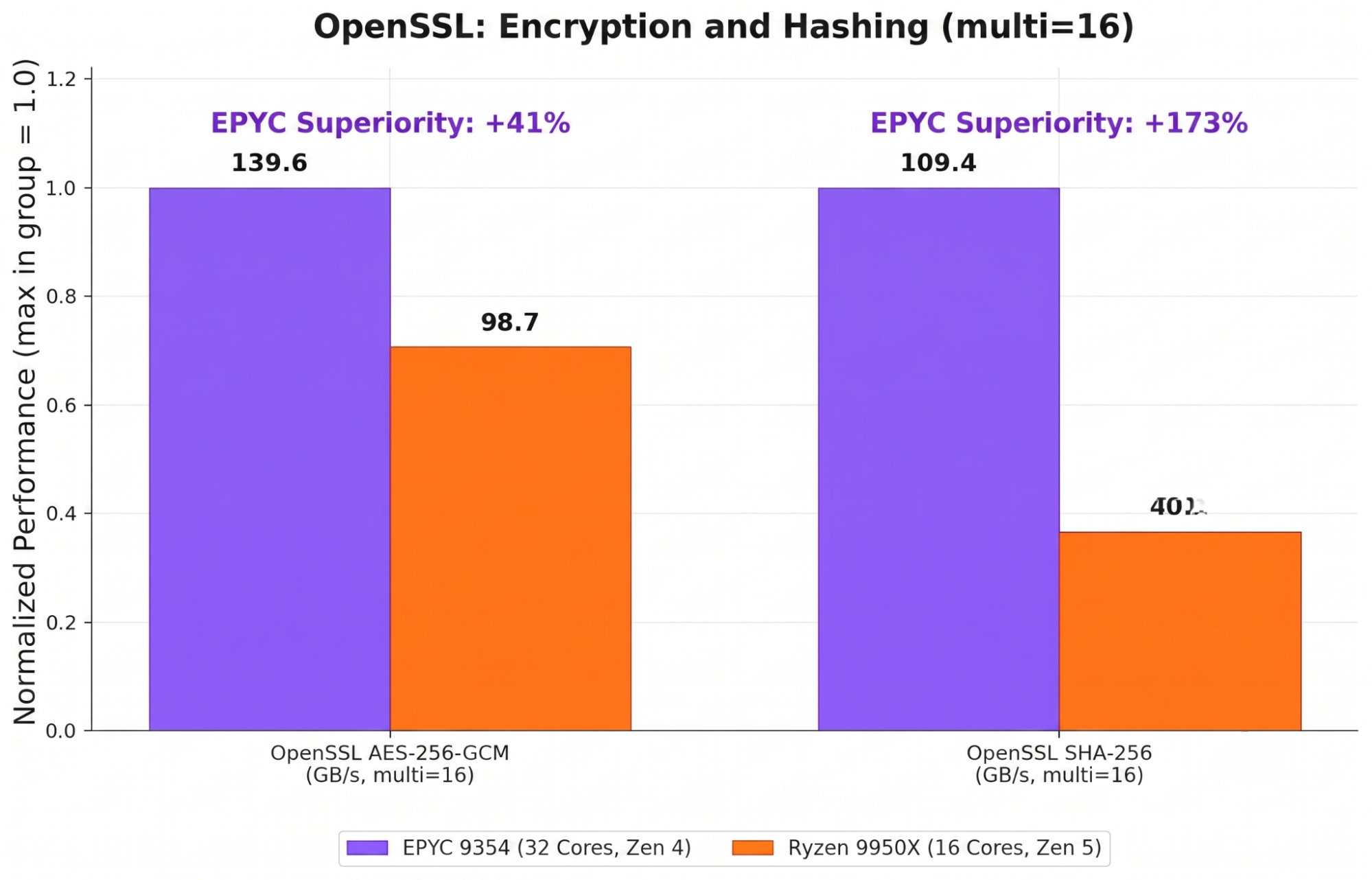
This matters for web servers handling high volumes of TLS handshakes, where hashing and asymmetric encryption are the primary drivers of load. It also applies to heavy compression/decompression tasks and large-scale project compilation.
PostgreSQL Under Parallel Load
This is perhaps the most relevant test for typical server workloads. We usedpgbench with a TPC-B style workload (OLTP standard) using a scale factor of 100, measuring Transactions Per Second (TPS) across varying numbers of concurrent clients.
|
Clients |
EPYC 9354 (TPS) |
Ryzen 9950X (TPS) |
EPYC Advantage |
|---|---|---|---|
|
10 |
3,849 |
2,842 |
+35% |
|
50 |
13,231 |
10,405 |
+27% |
|
200 |
22,780 |
18,634 |
+22% |
|
500 |
24,716 |
20,484 |
+21% |
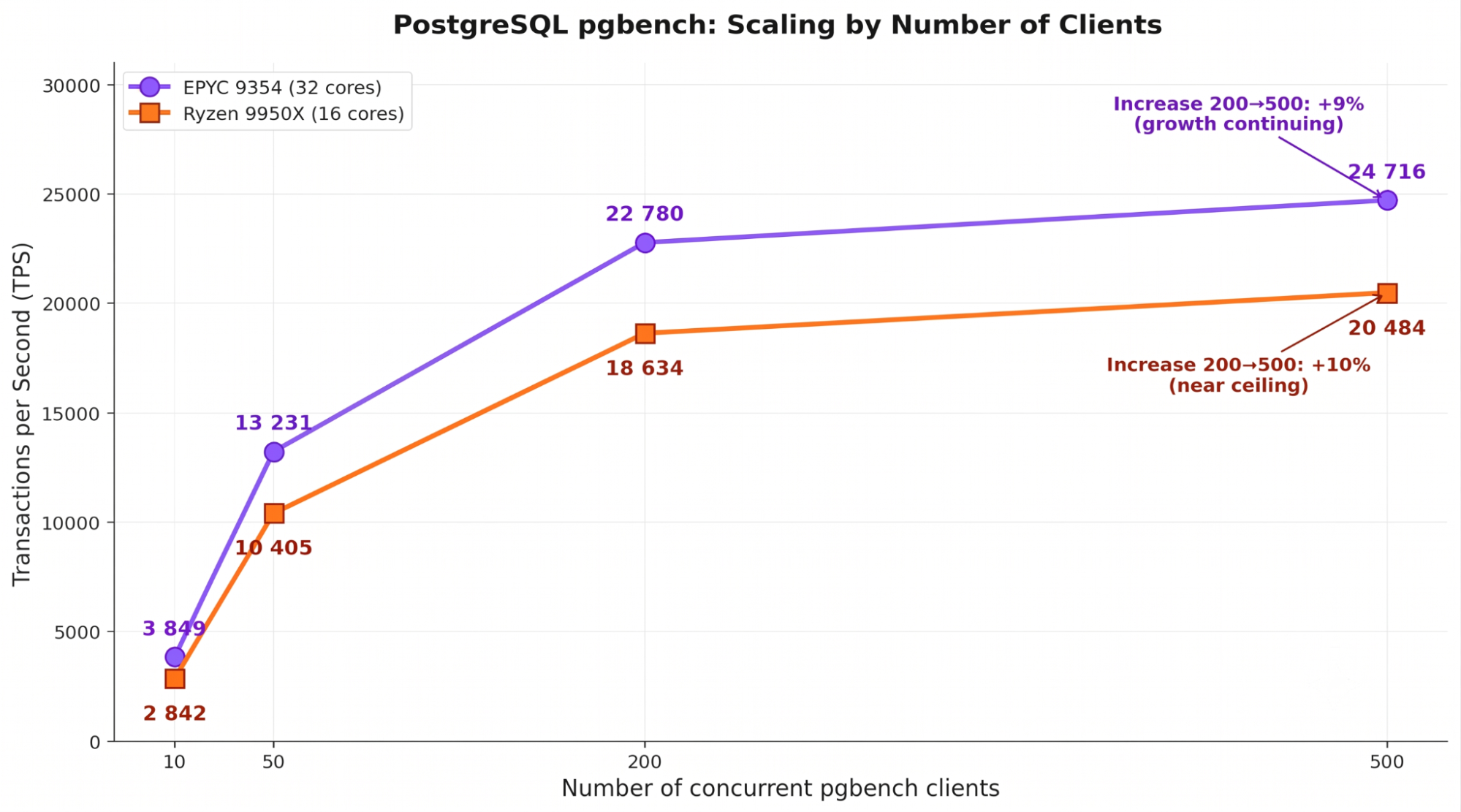
At low client counts, the ~30% difference is explained by clock speed and cache. What's more interesting is how the curves behave as load increases. Between 200 and 500 clients, EPYC shows steady growth (from 22,780 to 24,716 TPS), while Ryzen’s growth slows down significantly, with its curve visibly plateauing.
While we can only speculate on how they would perform at 1,000+ clients without further testing, the trend suggests that Ryzen will hit a hard ceiling much sooner than EPYC. Furthermore, because SMT is unavailable on our Ryzen bench, these numbers reflect the actual performance an enterprise user would see when running multiple database connections—each requiring its own process and physical core resources.
Multi-tenant Scenarios (Co-location)
In hosting, a single physical machine rarely runs just one application; it typically hosts multiple clients with varying workloads. To simulate this, we used stress-ng to run ten parallel workers. Each worker ran four CPU-intensive modules and two memory-intensive modules for five minutes.
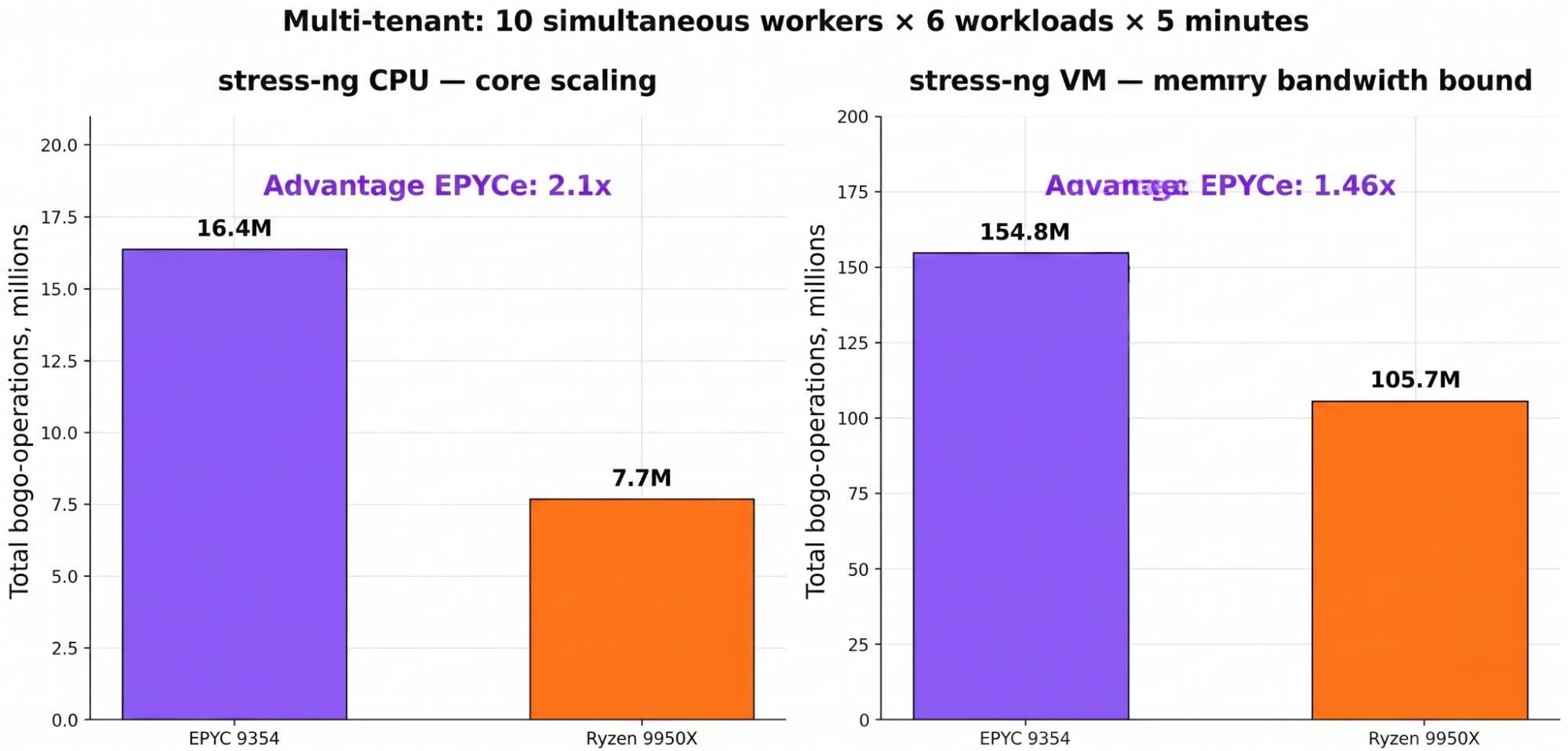
Two things became immediately clear:
- CPU Load: EPYC provided a 2.1x performance lead, scaling almost linearly with its double core count.
- Memory Load: The gap narrowed to 1.46x. As the bottleneck shifted from the CPU to memory bandwidth, EPYC's 12-channel architecture became more important than its core count.
The Ryzen results reflect the reality of a shared environment: as soon as you move beyond pure compute and into memory-heavy tasks, the architectural limitations of a consumer platform become apparent.
Server Features Missing from the Ryzen Architecture
Beyond raw performance, there is a suite of enterprise features that the Ryzen 9950X either lacks or implements in a limited capacity. Manufacturers often hide these differences behind generic terminology in technical documentation.
ECC (Error-Correcting Code) Memory: ECC detects and fixes single-bit errors on the fly. While some Ryzen consumer platforms claim "support," it is often restricted to UDIMM-ECC or specific motherboard layouts. On EPYC, ECC is mandatory; without it, the system won't even boot. This allows for the handling of both Single-Bit Errors (SBE) and Double-Bit Errors (DBE). In practice, a bit flip in RAM on an EPYC system is either corrected silently or logged. On a Ryzen system without ECC, that same error can lead to silent data corruption in your database.
RAS Features (Reliability, Availability, Serviceability): These are mechanisms designed for enterprise uptime. EPYC includes dozens of these, including Machine Check Architecture (MCA) for automatic recovery, Platform Security Processors (PSP), and hardware-level "poison" bit propagation to prevent corrupted data from spreading through the memory subsystem. Most of these features are absent or significantly reduced in consumer Ryzen chips.
Remote Management (IPMI and BMC): Server-grade EPYC boards include a dedicated Baseboard Management Controller (BMC) chip. This operates independently of the main CPU and OS, allowing you to connect via IPMI to monitor boot processes, reboot the machine, flash BIOS, or check thermal sensors even if the host OS is completely frozen. Consumer Ryzen boards lack this; if a server hangs, an administrator must physically visit the data center to intervene.
PCIe Lanes: The EPYC 9354 provides 128 Gen 5 lanes. The Ryzen 9950X provides 28, and roughly half of those are consumed by the chipset and integrated peripherals. While 28 lanes are plenty for one or two NVMe drives and a single NIC, they are insufficient for high-end configurations involving multiple NVMe RAID arrays, 100GbE NICs, and hardware accelerators (GPUs).
In summary, EPYC is significantly more predictable in production. For a provider, this means faster error detection (via ECC/RAS) and greater hardware expansion flexibility. With Ryzen, many of these enterprise scenarios require significant compromise.
Thermal Behavior Under Sustained Load
One of the most surprising results concerns thermal behavior rather than raw speed. In a standard 1U or 2U server chassis without liquid cooling, the Ryzen 9950X reaches temperatures as high as 96°C under sustained 100% load.
|
Metric after 30 mins of 100% Load |
EPYC 9354 |
Ryzen 9950X |
|---|---|---|
|
Max Temperature |
74.0°C |
96.4°C |
|
Average Temperature |
72.6°C |
96.2°C |
|
Max Frequency |
3,795 MHz |
5,315 MHz |
|
Min Frequency |
3,769 MHz |
4,917 MHz |
|
Frequency Throttling (under load) |
0.67% |
7.48% |
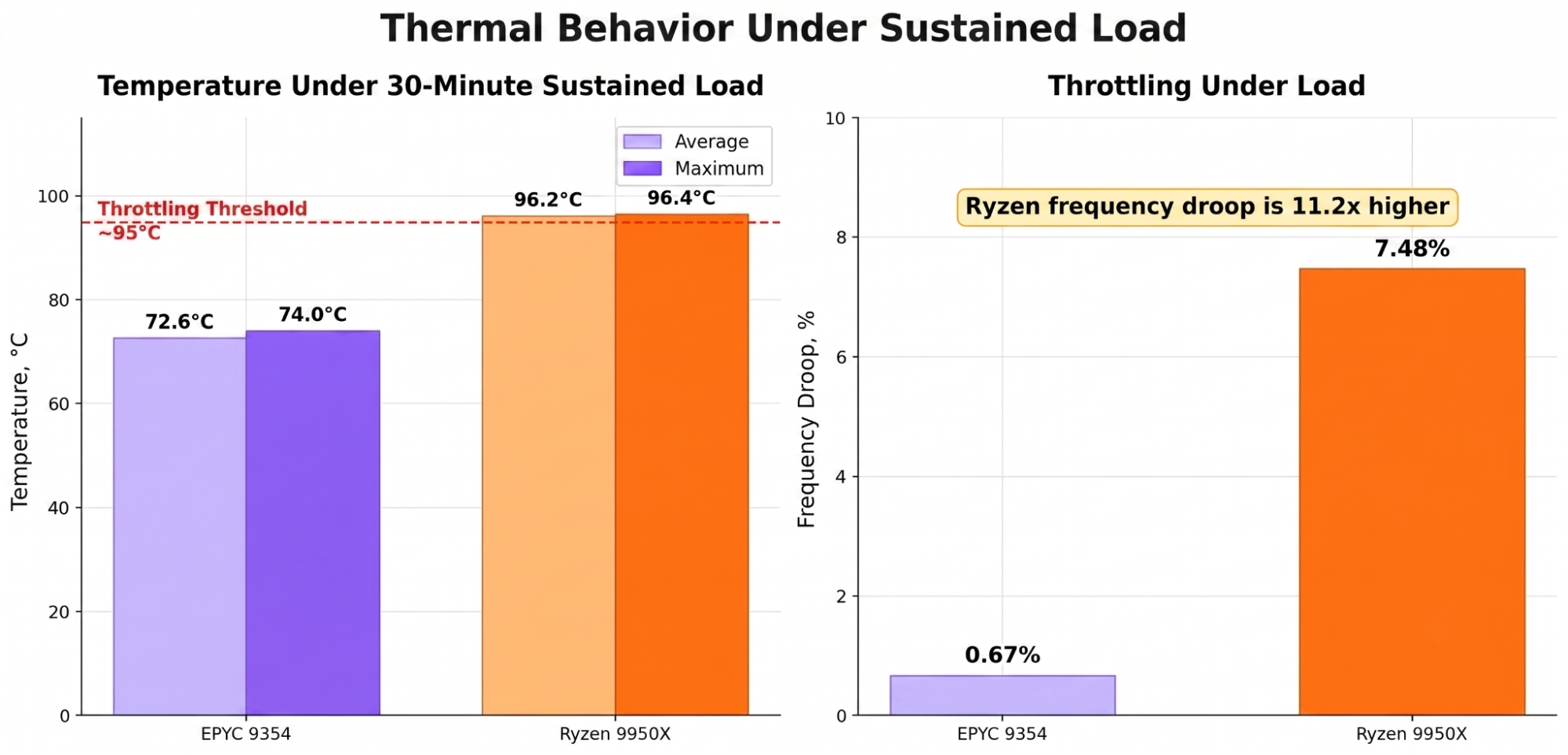
The Ryzen 9950X is designed for desktop scenarios with massive air or liquid cooling; in such a setup, it can maintain frequencies above 5 GHz indefinitely. However, a standard server chassis has limited space and relies on high-RPM, small-diameter fans. In this environment, the Ryzen hits its Tjmax (maximum operating temperature) of 95°C and begins to throttle, losing about 7% of its clock speed.
The EPYC 9354 is designed for a 280W TDP specifically within server cooling environments. It stays around 72–74°C—well below its thermal limit—with less than 1% frequency drop.
This has real-world implications: Ryzen fans will run at maximum RPM constantly, increasing noise and mechanical wear. While the manufacturer allows operation up to Tjmax, running perpetually near that limit leaves very little headroom for transient spikes or dust accumulation in the heatsinks. Over time, this necessitates more frequent maintenance compared to a processor operating comfortably at 70°C.
When is the EPYC Premium Justified?
The price difference at the time of testing was approximately $65 per month. The logical question is: when does that extra cost pay off? To answer this, we should look at "performance per dollar" rather than total price.
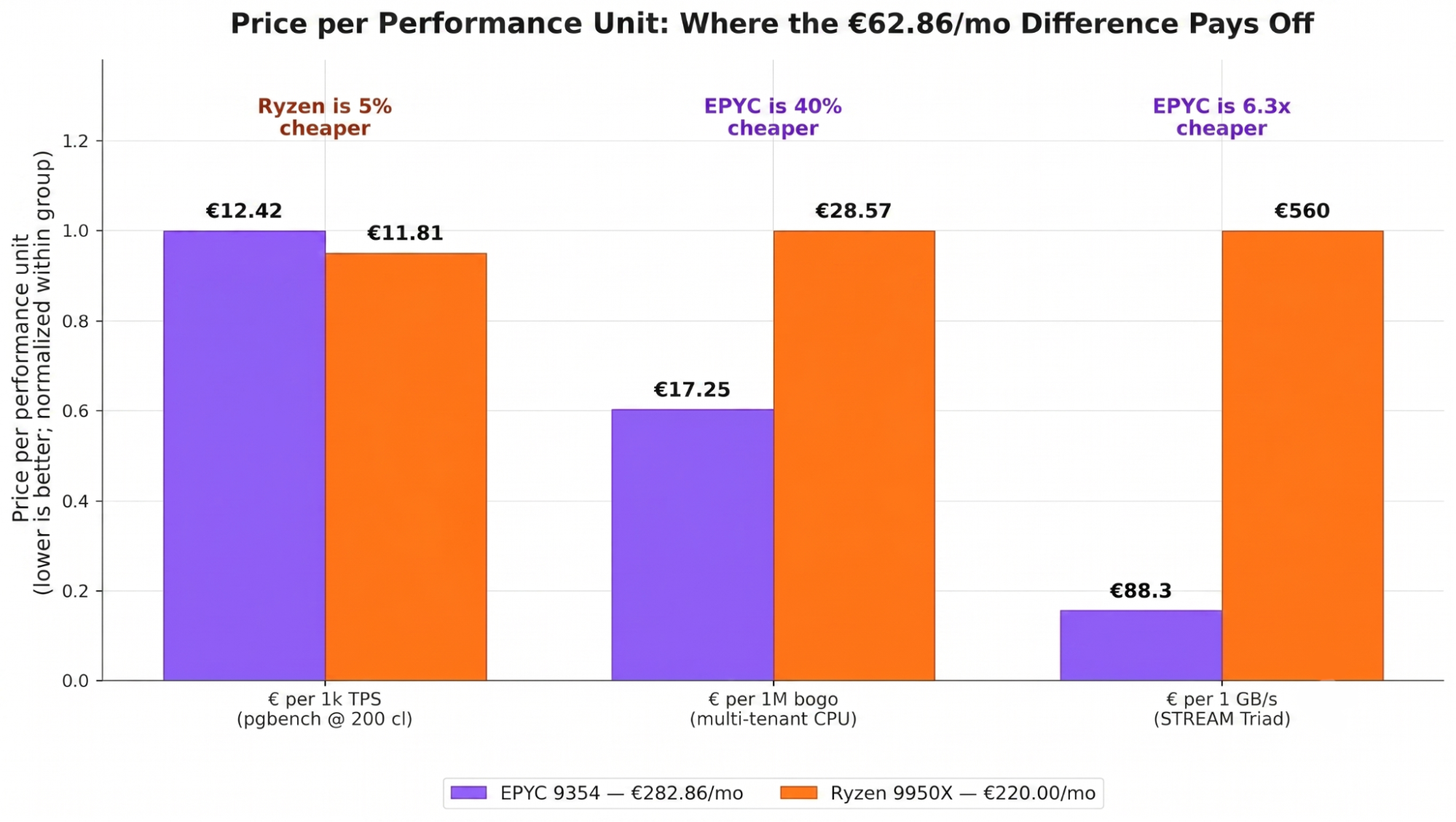
Ryzen 9950X is more cost-effective if:
- You are running a single application or website (not shared).
- Your workload is primarily single-threaded or has low concurrency.
- You are on a tight budget (~$200/month).
- Data integrity and uptime are not mission-critical (e.g., test/dev environments where ECC isn't required).
- A 1 Gbps network link meets your requirements.
EPYC 9354 is the better investment if:
- You run databases with high concurrency (100+ simultaneous clients).
- The server is shared between multiple customers or containers.
- Your workloads are memory-intensive (Redis, Memcached, ML inference).
- You require ECC memory for data integrity and compliance.
- You need remote management (IPMI) to handle OS crashes remotely.
- You require 10 Gbps+ networking or high PCIe lane counts for RAID/GPUs.
The line between these two is often blurred, and the decision ultimately rests with whoever understands their specific workload best.
Summary of Findings
Comparing the Ryzen 9950X and EPYC 9354 isn't about a single number; it depends on your workload. Ryzen wins in single-threaded benchmarks, loopback tests, and low-concurrency scenarios. EPYC leads in memory bandwidth (7–8x gap), multi-threaded throughput, thermal stability, and enterprise-grade reliability features.
Key Takeaways:
- Memory: 7–8x difference in bandwidth due to 12 DDR5 channels vs. 2.
- PostgreSQL: Ryzen's performance plateaus at high client counts, while EPYC maintains headroom.
- Multi-threading: EPYC provides roughly double the throughput in heavy multi-threaded tasks.
- Thermals: Ryzen operates near its thermal limit (Tjmax) with significant throttling; EPYC remains stable and cool.
- Enterprise Features: ECC, IPMI, and RAS features are native to EPYC but limited or absent on Ryzen.
The $65 monthly difference allows you to choose a purpose-built server CPU over a consumer chip in a server chassis. The value of that premium is realized when your workload demands the memory bandwidth, reliability, and management capabilities that only an enterprise architecture can provide.