



 +31 20 820 3777
 Compliance & KYC
 Support
 Documentation

 Login




Most hosting customers never think about how the data center housing their servers works. That goes, of course, for those with routine workloads and no special requirements for the facility. Yet keeping those conditions stable year-round is a complex engineering task. It is certainly a long way from launching a rocket, but it can't be done without professional engineers, and their mistakes can have painful and expensive consequences, as the outages of recent years make plain.
On July 19, 2022, temperatures in the UK topped 40°C, and Google and Oracle data halls in London went offline. One of the Google data centers hosted the europe-west2-a zone, where several redundant cooling systems failed at the same time, forcing some servers to be shut down. The consequences were serious because Google engineers also mistakenly pulled internal traffic out of all three zones in the region, not just the affected one. At the same time, a London hospital lost its IT systems to a cooling failure. Uptime Institute estimates the damage to the UK health system from this outage at £1.4 million.
A year later, a similar incident hit Singapore, this time with no extreme heat involved. On October 14, 2023, during a scheduled upgrade at an Equinix data center, a contractor mistakenly sent a signal to close the valves on the chilled-water tanks, and the temperature in the hall began to climb. As a result, some IT systems of DBS and Citibank, which hosted equipment in that building, stopped working, and services were fully restored only in the early hours of October 15. About 2.5 million payments and ATM transactions did not go through. The banks' backup sites failed to take over the load: at DBS because of a network misconfiguration, at Citibank because of connectivity problems. As a penalty, the Monetary Authority of Singapore barred DBS for six months from launching new business lines and from making IT system changes other than essential ones.
Every year, Uptime Institute surveys data center owners and operators about the main cause of the last serious outage at their site. Power remains the top cause by a wide margin, accounting for 44 to 56 percent of responses depending on the year. Cooling accounted for 13 percent in the 2022 and 2024 surveys and 19 percent in 2023. Outages themselves are becoming less frequent: in 2022, 60 percent of operators reported a significant outage within the previous three years, and by 2025 the figure was half.
The samples behind the outage-cause figures are fairly small, however. In 2025, for example, only 96 operators answered the relevant question, so a swing of a few percentage points does not by itself prove that infrastructure reliability has changed. The cost of outages remains high: in the 2025 survey, 57 percent of respondents put the cost of their last major outage above $100,000, and one in five put it above $1 million. In the 2023 survey, 80 percent of operators admitted that their last serious outage could have been avoided with better management and sound procedures.
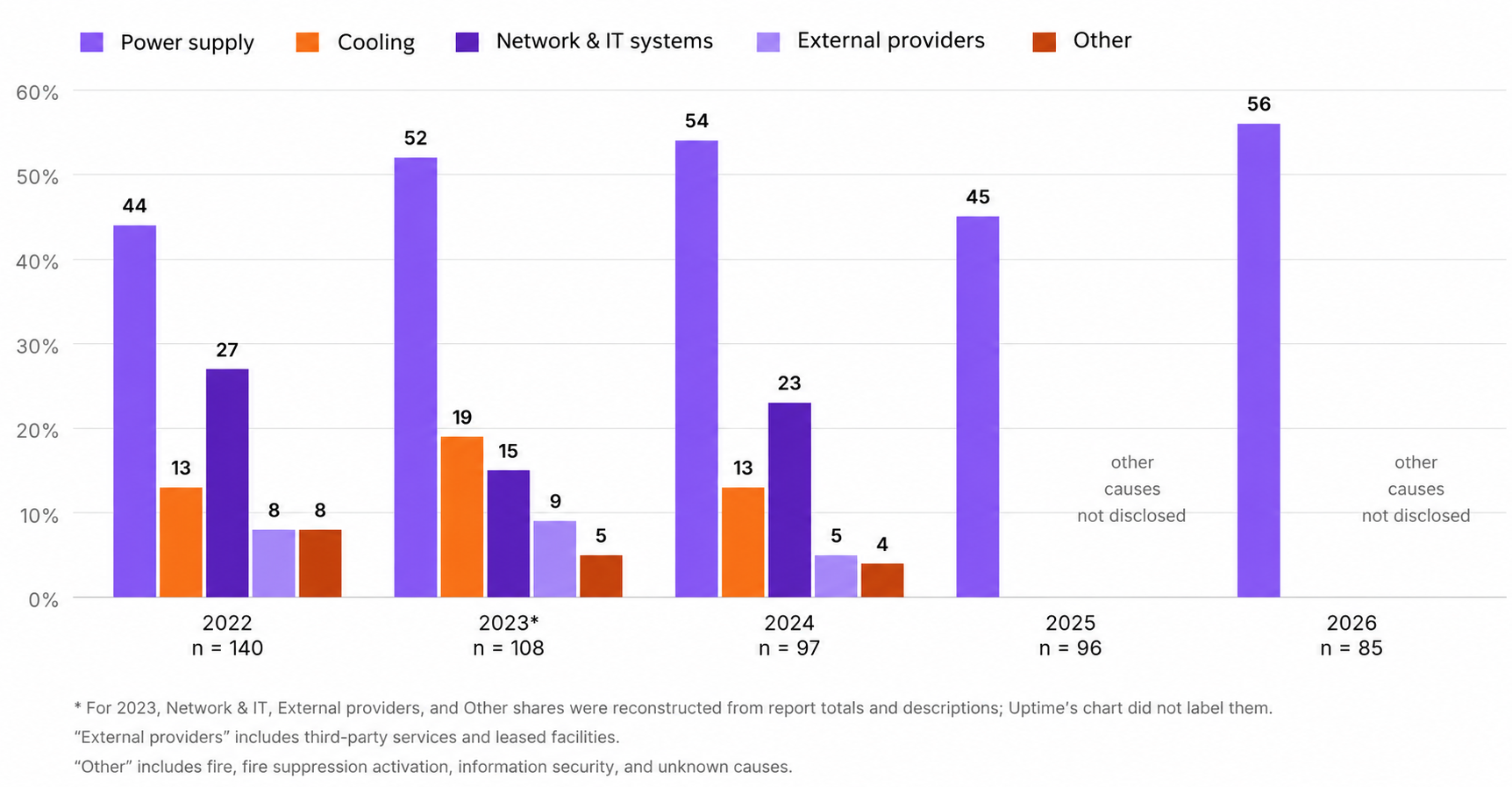
Main cause of the last significant data center outage, according to Uptime Institute surveys from 2022 to 2026. For 2023, some of the shares were reconstructed from the total and the description in the report; for 2025 and 2026, only the share for power has been published.
When server racks drew five or ten kilowatts, standard power distribution units (PDUs) and raised-floor air cooling were enough, so tenants rarely had to think about how to deliver sufficient electricity to their equipment or carry away the heat it produced.
The night of November 28, 2025, showed what happens when the heat can't be removed. A chiller plant failed at a CyrusOne data center near Chicago, and hall temperatures climbed above 38°C. As a result, the CME exchange halted futures trading worldwide for more than ten hours. CyrusOne representatives later said that staff and contractors had not followed the procedure for draining the cooling towers ahead of freezing weather.
AI servers give off far more heat. A single rack of NVIDIA accelerators now draws about 120 kW, roughly as much as thirteen ordinary racks, and racks rated for a megawatt already appear in published specifications. Removing that much heat with air, and delivering that much power over conventional 12 V and 48 V distribution, is becoming impractical. Over the past three years, engineers have therefore had to rethink almost the entire power and cooling infrastructure, from the substation to the processor die.
How Much Power an Accelerator Rack Draws
Uptime Institute's 2025 survey shows how far the new power requirements depart from what data centers are used to. Across the surveyed sites, the average of the most common rack density was about 9 kW; excluding sites with densities of 30 kW and above, it falls to 7.5 kW. Moreover, 82 percent of the operators who answered the question about maximum density have no racks at 30 kW or above. These figures show what loads data center infrastructure is mostly built for today, although they say nothing about the maximum allowable power of an individual rack.
The DGX A100, introduced in 2020, draws up to 6.5 kW; the 2022 DGX H100, up to 10.2 kW; and the 2024 DGX B200, up to 14.3 kW. Each contains eight accelerators. A single H100-generation server alone exceeds the power budget of an average rack, yet it takes up only eight of the rack's forty-plus units. NVIDIA's reference design for H100 clusters puts up to four such servers in one rack, which brings the rack's draw to 40.8 kW.
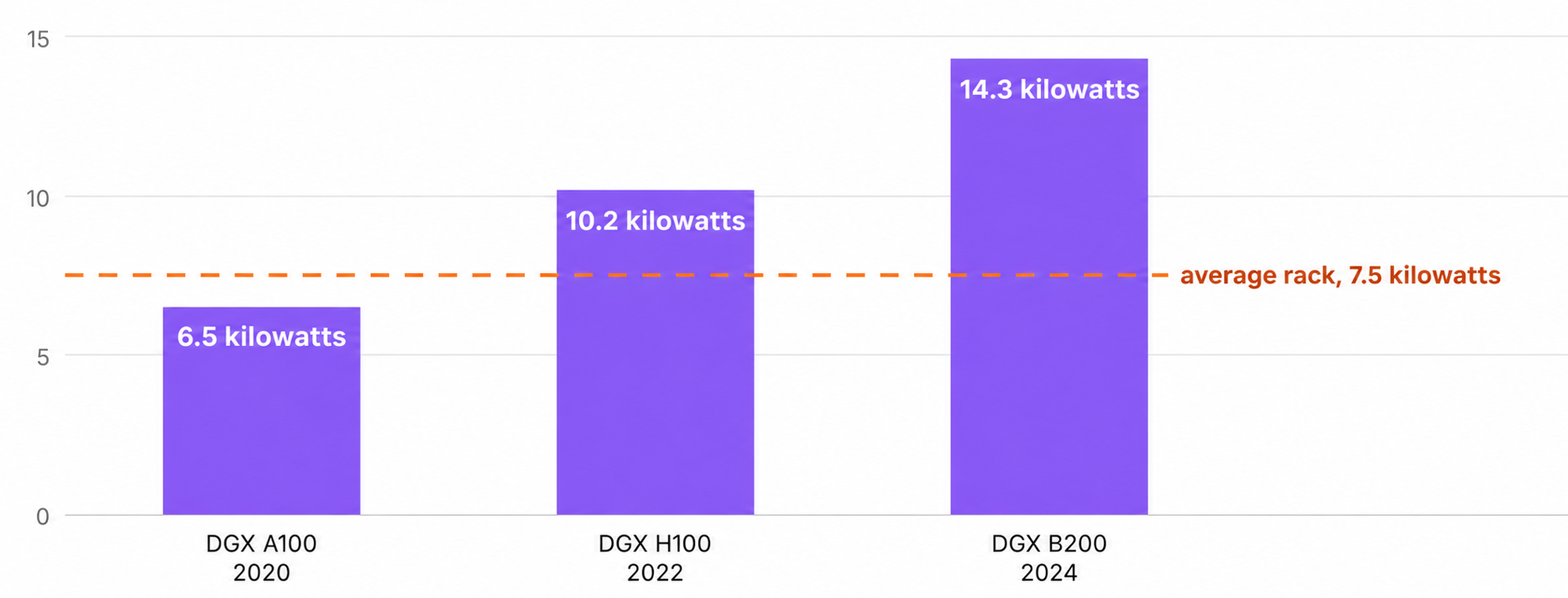
Power consumption of NVIDIA DGX servers with eight accelerators, according to the user guides. The dashed line shows the average rack density from the 2025 Uptime Institute survey, excluding sites with densities of 30 kW or higher.
NVIDIA's next step came at the level of the whole rack. The DGX GB200 NVL72 is sold as a complete rack with 72 Blackwell accelerators and draws about 120 kW. In 2025, NVIDIA began shipping its successor, the GB300 NVL72, which HPE rates at 132 kW nominal and about 155 kW peak. Further increases in density are, for now, tied to systems that are still in design. Google expects machine learning racks to need more than 500 kW by 2030, and NVIDIA plans to ship megawatt-class Kyber racks with a new power architecture in 2027.
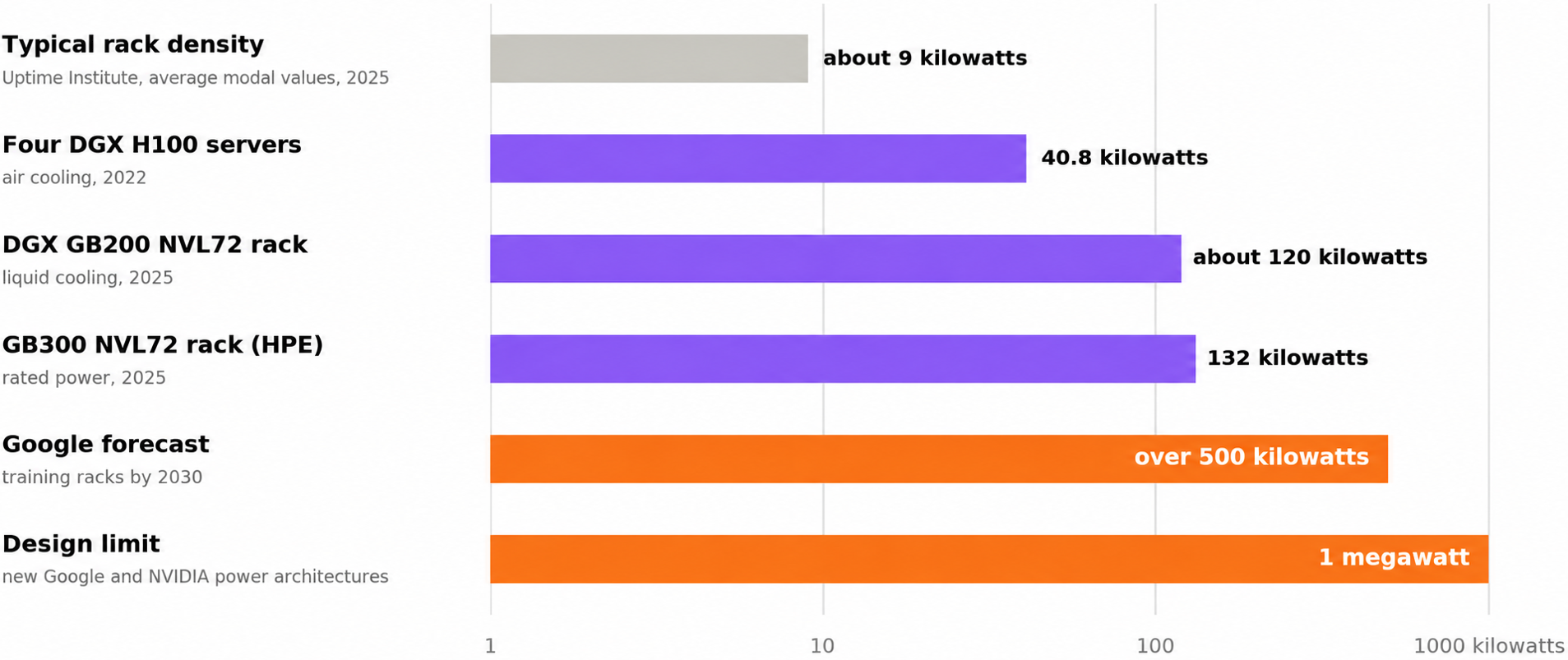
Power draw of a single rack, from the Uptime Institute survey average to the design limit of the new power schemes. Logarithmic scale; orange marks forecasts and design values.
Why Air Cooling Falls Short
Air is a poor medium for carrying away large amounts of heat. In 2021, the ASHRAE TC 9.9 committee, which develops industry guidance on environmental conditions in machine rooms, published some telling figures on this. The best perforated raised-floor tile passes about 1,900 cubic feet of air per minute (roughly 0.9 m³/s), while a rack of 40 or 50 kW may need up to 5,000 cubic feet.
You can check the ASHRAE estimate against four DGX H100 servers drawing 40.8 kW together. If the air heats up by 15°C as it passes through the rack, removing that much heat takes about 2.26 m³/s, or roughly 4,800 cubic feet per minute. That is close to ASHRAE's figure of 5,000 and about 2.5 times what a single perforated tile can deliver. On top of that, at high load densities the server fans alone can draw 10 to 20 percent of the equipment's power, so in a 50 kW rack they account for 5 to 10 kW.
The second reason is the growing power of the chips themselves. Where a chip once drew around 100 W, modern accelerators already exceed 1,000 W, and cooling requirements are tightening at the same time. As early as 2021, ASHRAE warned that the allowable case temperature of some processors would fall from 80 or 90°C to a little over 70°C. A heatsink has to shed far more heat across a smaller temperature difference, so its size and airflow demands grow, and fitting an effective cooling system inside the server gets harder and harder.
That said, air cooling is not disappearing from production use. The NVIDIA DGX B200 draws 14.3 kW and is air-cooled, and the manufacturer allows four of them in one rack, for a total of 57.2 kW, provided the data center is suitably prepared. As load density keeps rising, the capabilities of air cooling become more and more limited, and the 120 kW DGX GB200 NVL72 rack is offered only with liquid cooling.
What Is Replacing Air Cooling
Water carries heat far better than air: for the same temperature rise, it removes about 4,000 times more heat per unit of volume, and its thermal conductivity is about 30 times higher. To cool a 120 kW rack with a 10°C rise in water temperature, it is enough to pump about 2.9 liters per second, which a relatively small pipe can handle. Removing the same power with air heated by 15°C would take about 6.6 m³/s, or nearly 24,000 cubic meters per hour. That is more than 2,200 times the water's volumetric flow in this calculation, even though we assumed different temperature rises for the two coolants.
Nearly all AI servers use the same approach: cold plates. These are metal heat exchangers pressed directly against the processors and accelerators, with coolant pumped through them. In a DGX GB200 rack, the liquid runs through manifolds along the full length of the rack, flows through the plates and returns, while the networking components and drives are still cooled by fans. Circulation is handled by a coolant distribution unit, referred to as a CDU in the documentation. The CDU houses the pumps and a heat exchanger that passes heat to the data center's chilled-water system, keeping the server loop isolated from the building loop.
The method has a solid track record. Google has been liquid-cooling its TPU accelerators since 2018. Over seven years it has deployed more than 2,000 such clusters totaling roughly a gigawatt, and CDU availability has held at about 99.999 percent since 2020. It also turned out that a cold-plate server takes up almost half the space of an identical server with air-cooled heatsinks.
The coolant doesn't have to be cold. In Rubin-generation racks, liquid can enter at up to 45°C and leave at about 55°C. The coolant is a mixture of 75 percent water and 25 percent propylene glycol. With coolant at around 55°C, dry coolers that reject heat straight into the outdoor air become viable. In a sufficiently cool climate, this lets a facility do without chillers for most of the year, although supplemental cooling is still needed in hot weather. NVIDIA engineer Ali Heidari believes that in some climates chillers would have to run only about 1 percent of the year. Rubin systems have no fans at all; even the networking components are liquid-cooled.
Other approaches exist, such as rear-door heat exchangers and immersion in dielectric fluid. The documents we relied on say little about them, and we did not find them in any production AI racks, so we mention them only in passing.
Rack Power: From 12 Volts to 800
Current equals power divided by voltage, and resistive losses grow with the square of the current. The whole history of rack power follows from these two relationships. As long as a server drew a few hundred watts, 12 V was enough inside the rack. About ten years ago, Google proposed distributing 48 V through the rack, a scheme that carried racks from 10 kW to 100 kW.
In a DGX GB200 rack, the busbar voltage is 50 to 51 V, so at 120 kW about 2,400 A flows through the busbar. Power is carried by a massive copper busbar running the length of the rack. It is supplied by eight shelves, each holding six 5.5 kW power supply units, for a total rated power of 264 kW. The rack itself draws only about 120 kW, because the system uses N+N redundancy and keeps running even if half of the power supplies fail.
If the same scheme were stretched to a megawatt, the current would rise to about 18,500 A. Power shelves with 54 V units would take up to 64 rack units, more than the rack has, and the busbar would need up to 200 kilograms of copper. NVIDIA believes this approach hits its physical limits beyond roughly 200 kW per rack.
Google proposes a bipolar scheme with potentials of plus and minus 400 V, giving 800 V between the conductors. The power supplies and batteries move into a separate cabinet beside the rack, freeing space for computing equipment and, by Google's estimate, raising overall efficiency by about 3 percent. NVIDIA proposes 800 V DC, with 13.8 kV AC converted to DC right where power enters the data center, which the company calculates could raise the efficiency of the power system by up to 5 percent. At 800 V, a 1 MW rack would need 1,250 A, almost half the current of today's 120 kW DGX GB200, despite a power difference of more than eightfold. NVIDIA plans to launch the first production data centers with this power architecture in 2027.
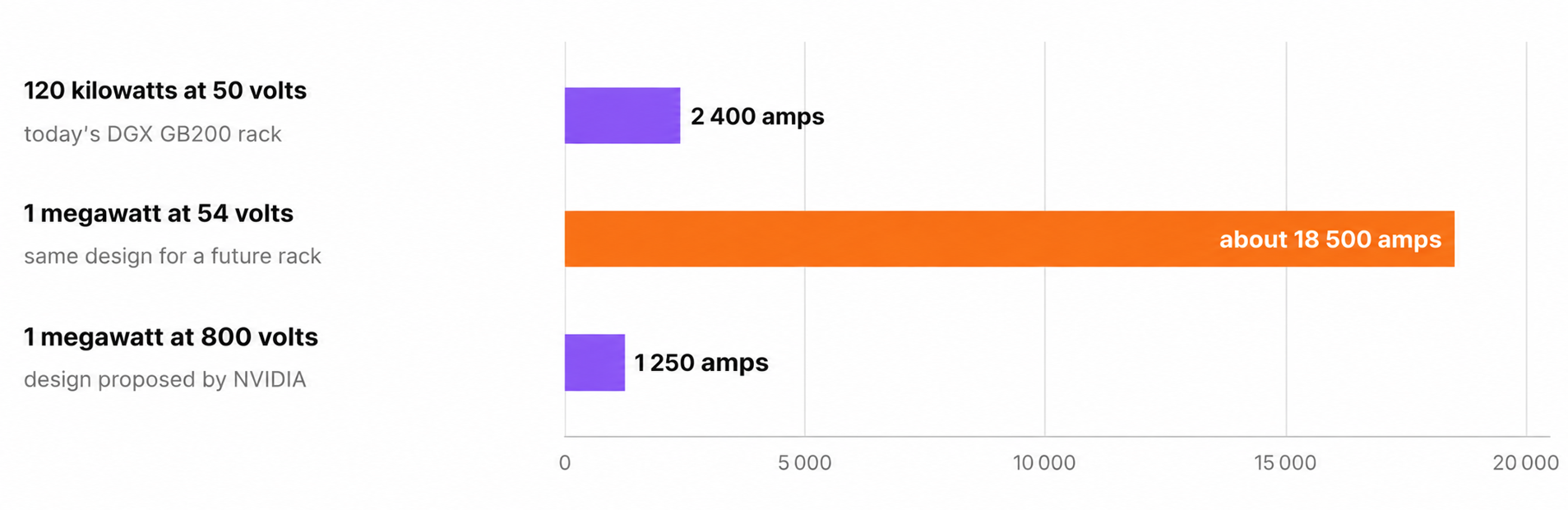
Current a rack needs at different supply voltages. Our calculation: power divided by voltage, ignoring losses; the power and voltage figures come from NVIDIA documentation.
When large neural networks are trained, thousands of accelerators switch in unison between intensive computation and data exchange, and power draw swings sharply. The power of a single rack can jump from about 30 percent to 100 percent and back within milliseconds, and across a large compute hall such swings reach hundreds of megawatts in a very short time, putting serious strain on the grid. To smooth them out, NVIDIA suggests two kinds of energy storage. Capacitors and supercapacitors next to the racks absorb swings lasting from milliseconds to seconds, while large batteries where power enters the data center handle slower load changes and carry the load while backup generators take over.
What Is Changing Inside the Data Center Building
Data center efficiency is usually measured by power usage effectiveness (PUE), the ratio of the facility's total power consumption to that of the servers inside it. The weighted average in 2025 was 1.54, the sixth year in a row with almost no change, compared with 2.50 in 2007. At a PUE of 1.54, every kilowatt used by servers is accompanied by another 0.54 kW for cooling, UPS losses and other supporting infrastructure. For a hypothetical data center with an IT load of 120 kW and a PUE of 1.54, the supporting infrastructure would draw about 65 kW more. At a PUE of 1.1, the overhead for the same IT load would be 12 kW, a difference of roughly 53 kW. This is an illustration for two hypothetical operating modes: the industry-average PUE cannot be used to estimate the overhead of any specific rack.
Data centers under five years old reported an average PUE of 1.48, and facilities of 20 MW and above reported 1.44. Liquid cooling can push PUE below 1.1, since most fans disappear and chillers run less often. NVIDIA estimates that a 50 MW data center could save more than $4 million a year on cooling and water, but this is the company's own calculation and cannot yet be independently verified.
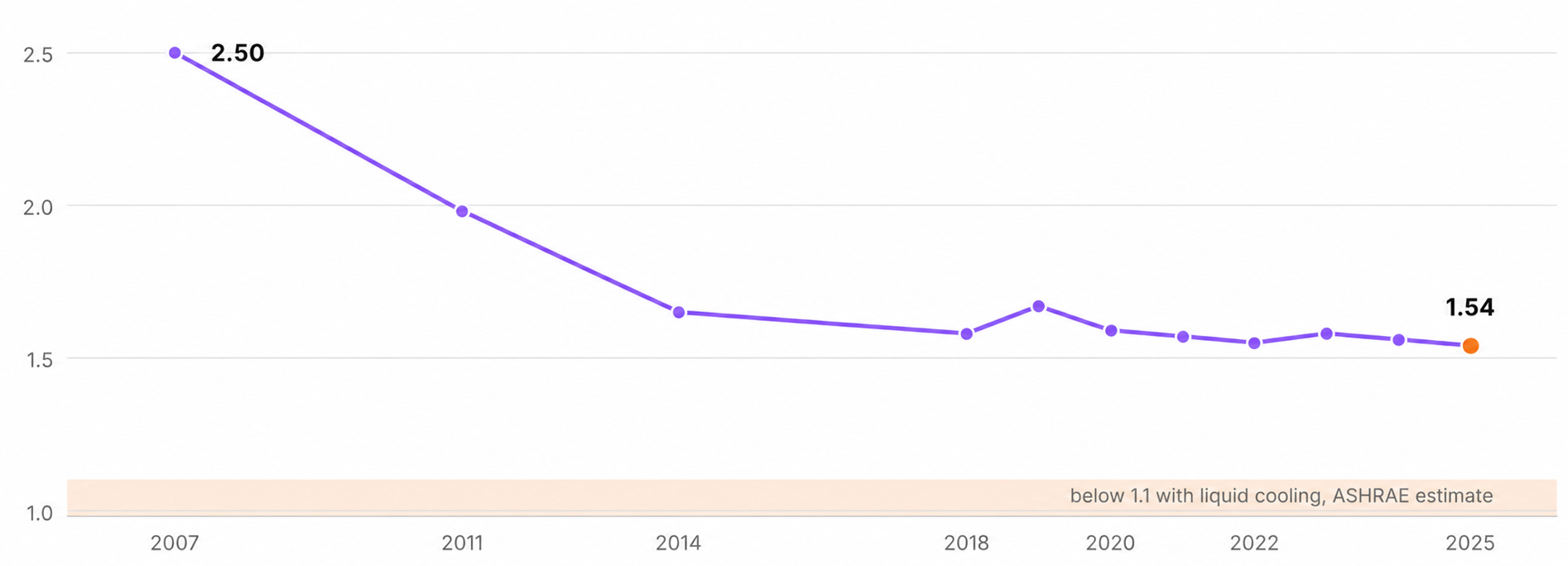
Weighted average PUE from Uptime Institute surveys, 2007 to 2025. The band at the bottom marks the sub-1.1 level that ASHRAE considers achievable with liquid cooling.
PUE accounts only for electricity, so it says nothing about how much water a data center uses for cooling. In a cold-plate loop, the liquid circulates over and over, so there is no need for a constant supply of fresh water to cool the servers. Water is consumed by evaporative cooling towers, and NVIDIA estimates this at about 2.6 million gallons per megawatt per year, or roughly 9.8 million liters. Hotter coolant makes it possible, in a suitable climate, to switch to dry coolers and stop evaporating water altogether.
Since August 2024, Microsoft has designed all new projects around cooling that does not evaporate water, and says this saves more than 125 million liters a year per data center. The company states plainly that giving up evaporation raises electricity use, but that the increase stays small thanks to the warmer loop.
The data hall itself is changing too. With air no longer the main heat carrier, raised floors with perforated tiles and alternating hot and cold aisles move into the background, while a new network of pipes, manifolds and leak sensors appears. For example, DGX GB200 racks include a leak detection system, because liquid is delivered directly to the compute modules. Fully liquid cooling also cuts noise in the data hall, which with traditional fan-heavy servers can reach 85 dB or more, according to NVIDIA.
How Much Electricity Data Centers Consume
In 2024, data centers worldwide consumed about 415 terawatt-hours, roughly 1.5 percent of global consumption, and that figure has been growing by an average of 12 percent a year since 2017. In the International Energy Agency's baseline scenario, data center consumption reaches about 945 terawatt-hours by 2030, more than double, and makes up slightly less than 3 percent of global consumption.
In the US, data centers account for a noticeably larger share of electricity than the global average. In 2023, US data centers consumed 176 terawatt-hours, or 4.4 percent of all electricity, up from 58 terawatt-hours in 2014. Researchers have put forward several scenarios with consumption between 325 and 580 terawatt-hours, which corresponds to a share of 6.7 to 12 percent. The upper bound is nearly double the lower one, a spread that shows how hard it is to forecast demand for AI computing.
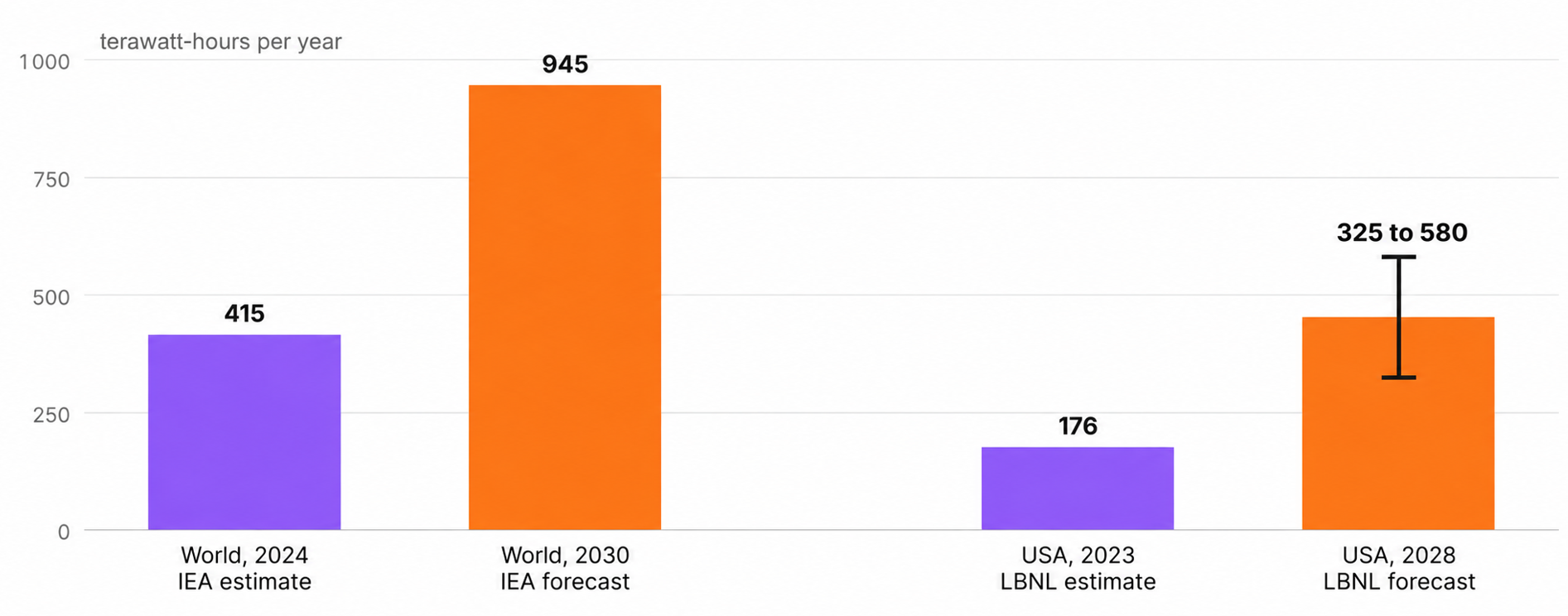
Electricity consumption of data centers, in terawatt-hours per year. Global figures are from the International Energy Agency report; US figures are from the LBNL report. Orange marks forecasts.
As load density rises, the main constraint on expanding a data center may become the available electrical capacity, even when the halls have plenty of room for more racks.
How Changes in Power and Cooling Affect GPU Server Rentals
Most tenants will never need a 120 kW rack, but even a single server with eight accelerators can draw 10 to 14 kW. For a facility designed for low rack density, that creates power and cooling limits even if the rack has plenty of free space.
So when choosing a data center, ask how much continuous power can be allocated to a specific rack, how it is split across independent feeds, and what load is allowed if one feed fails. Ask, too, for the rack's maximum cooling capacity: free rack units say nothing about whether you can install more powerful equipment.
Cooling capability matters just as much when you want to put several accelerators in one rack. NVIDIA DGX H100 servers with eight accelerators are still air-cooled, and an air-cooled rack can hold up to four DGX H100s. In that case the rack draws 40.8 kW, and the hall's cooling system has to remove almost that much heat. As early as 2021, ASHRAE recommended designing every new data center so that liquid cooling can be added later, so if you expect to move to denser systems in a year or two, ask whether the facility has made that provision.
The Equinix and CyrusOne incidents showed how heavily cooling reliability depends on following maintenance procedures. In Chicago, cooling failed because the seasonal maintenance procedure was breached, and the first attempts to fix it made matters worse. So when choosing a facility, find out how cooling maintenance is organized, whether similar incidents have occurred, and what was changed afterward.
There is also a less obvious detail concerning power supplies. The DGX B200 has six 3.3 kW units. Losing one power cord does not affect operation, but losing two cuts the power limit of each accelerator from 1,000 to 800 W. Training will not be interrupted, it will simply run slower, and the reduced power limit can be seen via nvidia-smi or in a warning from the management controller. Best practice today for deploying such servers is to spread the power supplies across independent feeds and monitor the controller's warnings, because an ordinary availability check will not reveal that a server is running at reduced performance.
Limitations of These Estimates
The rack design estimates in this article come mostly from NVIDIA, Google and Microsoft materials, and these companies develop the systems themselves. We found no independent confirmation of the promised 5 percent efficiency gain or the $4 million annual savings. As of November 2026, megawatt racks and 800 V power remain only plans, and release dates may slip. Electricity forecasts are also highly uncertain, since estimates can diverge widely even within a single report.
Immersion cooling, heat reuse, on-site power generation at data centers, and the cost of all of the above are outside the scope of this article. We found no open statistics for Russian facilities comparable to the Uptime Institute survey, so the average figures in the article refer to the world as a whole.