



 +31 20 820 3777
 Compliance
  Support
  Documentation
 Login
Login 




In 2023, I was asked to assist with a literature review for a final thesis. The task was to curate a list of sources for the research and format them according to strict academic standards. It was a tedious, meticulous, and frustratingly granular task. At the time, the "Artificial Intelligence" hype was already in full swing, so I decided to use ChatGPT to handle this soul-crushing workload. The results were initially spectacular: the list was perfectly formatted, sources were categorized correctly, and everything was alphabetized—it was flawless. There was just one problem: not a single one of the 55 sources actually existed. The model had completely hallucinated them. You might be tempted to say the model is broken or useless, but after I gathered a list of actual, existing materials, ChatGPT successfully formatted them exactly as required. It was a minor task, but the lesson was profound: use the tool for what it is actually capable of doing, not for what the marketing promises.
Three years have passed, and the debate over what generative models provide versus what they take away has only intensified. While model developers continue to make sweeping promises, the opposition to this new technology is growing. Distinguishing verifiable facts from the emotional rhetoric of both sides has become increasingly difficult. It makes sense to start with what can be quantified—the actual scale of the phenomenon—before we dive into the grievances.
The Current State of the AI Market
First, a quick disclaimer. We recognize that the term "Artificial Intelligence" is often used loosely in public discourse; since LLMs possess roughly as much "intelligence" as a calculator, it would be more accurate to speak of generative models. However, we will use both terms, as both have become firmly established in both technical debates and academic research.
The actual number of companies utilizing AI remains unknown, with only rough estimates available. Estimates vary wildly—ranging from just over 5% in the U.S. Census Bureau's BTOS survey to 78% in the Stanford HAI AI Index 2025 report. This massive discrepancy stems from the difficulty of establishing a standardized methodology. Official statistics are typically gathered through enterprise surveys, but many companies are reluctant to disclose exactly how and where they deploy these technologies. Furthermore, models deployed on on-premises hardware leave no footprint for service providers to track, making it impossible to calculate usage from the outside.
To understand this gap, let’s take a closer look at the data sources:
|
Source & Year |
Metric (%) |
Methodology/Scope |
|---|---|---|
|
U.S. Census BTOS, Feb 2024 |
5.4 |
Experimental statistics based on usage over the previous two weeks. |
|
ONS, UK, 2023 |
9 |
Only accounts for permanent integration into workflows; pilots and trials are excluded. |
|
Statistics Canada, Q2 2025 |
12.2 |
Any usage recorded within the last twelve months. |
|
Eurostat, EU-27, 2025 |
19.95 |
Enterprises with 10+ employees that identified at least one technology from a predefined list (e.g., speech recognition, machine learning, warehouse robotics), not just LLMs. |
|
OECD, 2025 |
20.2 |
A composite of national surveys; the European portion utilizes the same methodology as Eurostat. |
|
IBM Global AI Adoption Index, 2024 |
42 |
Responses from executives at organizations with 1,000+ employees; commissioned by IBM, a vendor of enterprise AI systems. |
|
McKinsey State of AI, 2025 |
71 |
Self-reported; includes any form of regular generative model usage. |
While this table is only a small subset of the available data, the gap between the lower and upper bounds is striking. Official statistics tend to capture AI only when it is deeply integrated into core business processes, whereas surveys often capture any usage—including an individual employee's private subscription that the company may not even be aware of. Additionally, companies involved in the creation and promotion of AI tools have a vested interest in projecting an image of massive, skyrocketing demand.
The Eurostat data, which has been collected since 2018 and is broken down by enterprise and industry, offers a more objective view:
|
Year |
EU Enterprise Share (%) |
YoY Change |
Note |
|---|---|---|---|
|
2018 |
~6 |
— |
Initial study |
|
2023 |
8 |
— |
First use of unified methodology |
|
2024 |
13.48 |
+5.48 pp |
Added specific questions regarding generative models |
|
2025 |
19.95 |
+6.47 pp |
The EU adoption rate grew from 8% in 2023 to 13.48% in 2024, reaching 19.95% in 2025—meaning the majority of growth occurred in just the last two years. Adoption rates also vary significantly based on company size:
|
Enterprise Size (Employees) |
EU (%, Eurostat, 2025) |
US (%, BTOS, 2024) |
|---|---|---|
|
Micro (1–9) |
N/A |
~3 |
|
Small (10–49) |
17 |
~5 |
|
Medium (50–249) |
30.36 |
~7 |
|
Large (250+) |
55.03 |
10.5–13 |
The most telling trend is the widening gap between small and large enterprises, which remain the primary drivers of AI integration into production workflows. Large corporations heavily influence model usage statistics and generate the majority of the headlines, creating the illusion of ubiquitous AI adoption. However, this perception is often misleading and is more a reflection of the current public discourse than actual market penetration.
The reasons behind this staggering adoption gap between large and small enterprises are critical. According to various surveys, one of the primary obstacles for small businesses is the lack of specialized personnel—specifically, those capable of defining AI implementation requirements and those qualified to execute them. While AI can automate routine tasks, integrating it into a professional workflow is a distinct challenge requiring its own set of specialized competencies. While you may find individual "early adopters" who take it upon themselves to teach colleagues how to prompt or work with models, these are exceptions rather than the rule. For full-scale deployments—such as corporate chatbots, automated support bots, or other custom solutions—there must be a human operator responsible for maintaining that infrastructure.
Currently, this problem is only being partially mitigated by the declining cost of premium, off-the-shelf SaaS subscriptions. To see how this is playing out across different sectors, let’s examine the data from the Eurostat isoc_eb_ain2 dataset:
|
Industry |
2023 (%) |
2024 (%) |
2025 (%) |
2025 YoY Growth |
|---|---|---|---|---|
|
Telecommunications, Software, & Publishing |
29.53 |
48.72 |
62.52 |
+13.80 pp |
|
Professional & Scientific Services |
18.66 |
30.53 |
40.43 |
+9.90 pp |
|
Energy & Gas |
18.43 |
25.68 |
33.57 |
+7.89 pp |
|
Real Estate |
8.5 |
15.45 |
24.76 |
+9.31 pp |
|
Economy Overall (excl. Finance, Agri, Mining) |
8.06 |
13.48 |
19.95 |
+6.47 pp |
|
Administrative Services |
8.33 |
14.33 |
19.86 |
+5.53 pp |
|
Retail & Repair |
6.74 |
12.11 |
18.62 |
+6.51 pp |
|
Manufacturing |
6.79 |
10.57 |
17.27 |
+6.70 pp |
|
Water, Sewage, & Waste Management |
5.65 |
8.38 |
13.12 |
+4.74 pp |
|
Hotels & Restaurants |
3.81 |
6.09 |
11.98 |
+5.89 pp |
|
Transportation & Warehousing |
5.26 |
8.13 |
11.15 |
+3.02 pp |
|
Construction |
3.2 |
6.09 |
10.79 |
+4.70 pp |
In 2024, the Telecommunications and Software sector jumped by 19.19 percentage points, but that momentum slowed to 13.80 in 2025. We see similar deceleration in Professional and Scientific Services (from 11.87 to 9.90 pp) and Administrative Services (from 6.00 to 5.53 pp). Essentially, the sectors that previously acted as AI engines have begun to plateau, while almost every other industry saw an acceleration in 2025. The hospitality sector (Hotels & Restaurants) grew by 2.28 pp in 2024, but surged by 5.89 pp in 2025—a 2.5x increase in growth rate. Manufacturing and Construction also saw acceleration, with growth rates rising from 3.78 to 6.70 pp and 2.89 to 4.70 pp, respectively. The Energy sector remains the outlier, maintaining consistent momentum with growth rates of 7.25 and 7.89 pp.
The gap between Telecommunications and Construction continues to widen: it stood at 26.33 pp in 2023, grew to 42.63 pp in 2024, and reached 51.73 pp by 2025. Interestingly, while the absolute gap is expanding, the rate of divergence is slowing as the incremental growth in the gap dropped from sixteen points to nine.
While statistics alone don't provide explanations, we can make several educated assumptions. With Telecommunications and Software reaching a 62.52% adoption rate, the remaining 37% likely represents companies that have yet to implement anything despite years of market hype. This slowdown looks more like market saturation. The variance between industries also depends on the nature of the work: in Telecommunications and Professional Services, the core output is text or code—the exact domains where models integrate seamlessly—and the necessary talent is readily available.
The situation is different for Hospitality, Construction, or Logistics. In these sectors, AI is used more as an "add-on" to the core product (handling correspondence, scheduling, booking, etc.). These features are often built into existing vertical-specific software that emerged after the LLMs themselves. This is indirectly supported by the fact that only 2.77% of enterprises implemented the technology using their own staff, compared to 13.48% who use it generally—meaning only about one in five companies is doing it in-house. The rest are waiting for their software providers to integrate these features into their existing systems. It is also worth noting that these statistics do not capture the depth or scale of implementation.
Industry leaders echo this sentiment regarding the complexity of AI deployment. For example, Caterpillar's CTO has noted that integrating new technologies into specific operational sites is a massive undertaking. Caterpillar sells autonomous construction equipment and voice assistants that can provide real-time troubleshooting and maintenance advice directly from the machine. It is a sophisticated, expensive solution: it operates across 1.5 million connected machines and processes 16 petabytes of proprietary data. To support this, Caterpillar is investing $100 million over five years into training staff in AI, autonomous systems, and robotics for its 118,000-person workforce.
Finally, a fascinating detail from the same Eurostat report: the disparity between EU member states is even wider than the disparity between industries. Denmark has reached a 42.03% adoption rate, while Romania remains at 5.21%—an eightfold difference. Northern European countries (Denmark, Finland, Sweden) are the leaders, followed by Belgium, Luxembourg, and the Netherlands. The pace of adoption is also much faster in the North; Denmark’s growth in 2025 alone (+14 pp) was greater than the entire total adoption rate of Portugal (11.54%). Greece was the only country to see its adoption rate decline over the year.
# How Many People Use Generative AI Models?
The exact number of people using generative models remains unknown. While gathering precise statistics is nearly impossible, various attempts have been made to quantify the market. In 2025, OpenAI representatives reported 800 million weekly ChatGPT users, and more recently, that figure was updated to one billion. While these numbers are impressive, they are typically released for promotional purposes, and the underlying methodology is rarely disclosed. Furthermore, simply aggregating the user bases of different services is misleading—the same individual might use ChatGPT, Gemini, Midjourney, and a dozen other services, while also running models locally.
However, more reliable data sources do exist. Microsoft has tracked the adoption of generative models using its own telemetry (the methodology is described here), adjusting for operating system market share, internet penetration, and population. Based on this data, 16.3% of the global population used generative models in the second half of 2025, up from 15.1% in the previous half-year. Similar figures have been reported by an independent scientific panel at the UN, stating that over a billion people use conversational models weekly. It is important to note that this represents only a subset of the total generative AI ecosystem.
Microsoft's data also highlights a growing digital divide: wealthy nations are adopting generative models at a significantly faster rate than developing ones. The United States leads in adoption with 64%, followed closely by Singapore at 60.9%. Interestingly, the U.S. ranks only 24th in terms of general generative model usage (28.3%), which is somewhat surprising for the country where much of this technology is developed.
The takeaway from these statistics is clear: generative models are becoming increasingly ubiquitous. They appeal to everyone from individuals generating cat images or debating world domination with chatbots to major corporations striving to boost their bottom lines. While this growth seems positive, the AI hype cycle is accompanied by a growing number of detractors. Next, we will examine who these "AI Luddites" are and why they are opposing the technology.
What Is Happening to Jobs?
The impact of AI on employment is perhaps the most discussed topic in our recent coverage, so we will dedicate significant attention to it. When we began exploring this subject, we expected to find the most rigorous analytics and documented risks regarding the displacement caused by generative models. However, we found something unexpected. The warnings about the impending obsolescence of half of all professions are not coming primarily from workers, labor unions, or academia; instead, they are being driven by the CEOs of generative AI companies and business leaders themselves. In short, their forecasts can be summarized by a slightly modified version of this meme:
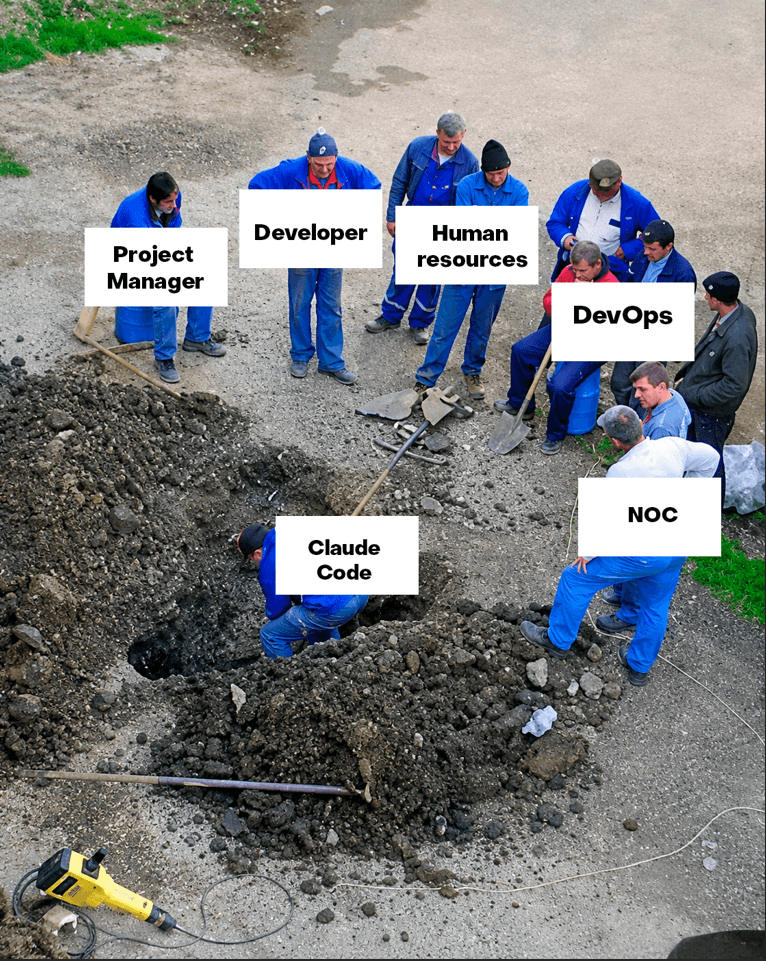
In fact, some employees take this to an absurd extreme, perceiving the end result of AI integration approximately like this:

Examples of such failed approaches are detailed here, here, and here.
Academic researchers tend to be the most cautious, and we turn to them as a source motivated by the need to protect their professional reputation. Petrashka and Byrlan investigate the impact of automation and large language models (LLMs) on the labor market, focusing primarily on how innovation affects worker positioning. Their findings are nuanced and can be summarized as "it depends"—they failed to find a clear, direct correlation between automation and a decrease in total jobs or a degradation of working conditions.
For instance, an analysis of statistics from 3,500 Chinese industrial enterprises revealed that while implementing new technologies reduces headcount, it simultaneously raises wages for the remaining employees. Conversely, researchers suggest that industrial robotics has led to a 1.3% decrease in global employment, with impacts in developing nations reaching as high as minus 14%.
The authors specifically tested whether AI-related job shifts differ from general automation trends and found no significant difference. A notable strength of this study is its scope: it covers automation broadly rather than focusing solely on generative models. The authors found no measurable difference in employment impact between implementing robots versus integrating chatbots into workflows. Ultimately, the consequences of these processes depend entirely on how they are managed.
In the World Bank report Labor Demand in the Age of Generative AI, the focus shifts to how the release of ChatGPT has impacted the US labor market. The authors analyzed 285 million US job postings from early 2018 through mid-2025. A key reason we selected this study is that the authors bifurcated the problem into two distinct metrics: whether a new technology is applicable to a profession's tasks, and the degree to which a specific role can be fully offloaded to a model. For the latter, they utilized a six-factor framework:
- Requirement for human interaction;
- Accountability for outcomes;
- Physical working conditions;
- Task criticality;
- Routine nature (whether tasks follow a fixed script or require novel problem-solving);
- Qualification requirements.
For example, a model might perform the tasks of both a secretary and a university professor, but in practice, a secretary is highly replaceable, whereas a professor is not. A significant portion of a professor's work involves real-time human interaction, adaptive teaching methods, and a high level of accountability—areas where generative models serve only as a supplement. The authors use the data entry operator and the driver as a clear comparison; while the logic is self-evident, the defining factor is the accountability for errors. The authors also note that generative models are fundamentally inapplicable to certain professions, such as police officers and dentists.
The authors then compared job postings for pairs of professions that share similar AI applicability but differ in "replaceability." The figures below represent the difference between these groups rather than total market contraction. The results show an average decline of approximately 12% in job postings over the study period, with the rate of decline accelerating year-over-year—from 6% in 2023 to 18% in 2025.
While this study may validate the fears of AI skeptics, it is important to note that the authors do not account for the creation of new professions resulting from the development of generative AI and its supporting infrastructure.
Nassim Deush's review encompasses 94 papers regarding the impact of AI on the labor market. We find it particularly relevant because it directly examines job posting attrition. In developed countries, job postings for entry-level and mid-level positions in software development, copywriting, and image generation dropped by 14% to 41% between 2022 and 2024. On freelance marketplaces, copywriting orders fell by 21% in the six months following the release of ChatGPT, while data labeling—a task models now perform themselves—dropped by 18%.
Unlike the previous study, Deush highlights the positive impact of generative AI on the labor market. An analysis of LinkedIn data across 18 countries showed that while job postings suitable for model replacement decreased by 14%, there was a 26% increase in "human-in-the-loop" roles, where humans work alongside AI. Additionally, vacancies in cybersecurity and code review grew by 36% over two years. The author concludes that it is not the professions themselves that are becoming obsolete, but rather traditional workflows.
Is Search Traffic Disappearing?
While the impact of generative AI on the labor market is nuanced, the decline in search traffic is causing tangible harm to website owners. For instance, global Google search traffic to news sites dropped by one-third by November 2025 according to recent reports. While Google Discover briefly mitigated these losses, it also saw a 21% decline during the same period. The following data highlights the situation, noting that the figures reflect a drop from a prior peak:
|
Traffic Source |
Year-over-year to Nov 2025 (%) |
May 2023 to Nov 2025 (%) |
|---|---|---|
|
Google Search, Global |
-33 |
-21 |
|
Google Discover, Global |
-21 |
-18 |
|
Google Search, USA |
-38 |
-22 |
|
Google Discover, USA |
-29 |
-22 |
Major US social media platforms stopped promoting news content several years before the AI boom, causing news outlets to lose traffic even then. However, 2025 saw a slight rebound, with social media traffic increasing by 10–15%.
The situation is grim for news organizations, though they are faring better than smaller sites. According to Axios, search traffic for sites with 1,000–10,000 daily views has plummeted by 60% over two years. Mid-sized sites (up to 100,000 views) lost 47%, while large-scale sites (over 100,000 views) saw a 22% decrease.
This discrepancy likely stems from the fact that major outlets possess established audiences and high direct traffic. Smaller sites rely heavily on SEO, making them vulnerable to "zero-click" search results, where the search engine provides a summary directly in the SERP. Consequently, websites are closing; for example, NPR reports that the travel blog The Planet D shut down after a 90% drop in traffic, while CNN saw a 30% decline, and Business Insider and HuffPost saw drops of approximately 40%.
One might hope that chatbot referrals would offset these losses, but that hope has not materialized. While ChatGPT referrals more than doubled in a year, they represent only 0.02% of total traffic, and Perplexity accounts for a mere 0.002%—statistically negligible figures that offer no relief to publishers.
SparkToro's click data is equally discouraging and excludes iPhone users. In 2024, for every 1,000 searches in the US, only about 360 clicks went to non-Google websites; in the EU, that number was 374. By 2026, this fell to approximately 230—less than a quarter. The remaining queries either result in no click or lead to Google-owned services like YouTube, Maps, or Images, which capture nearly 30% of all clicks.
There is, however, a silver lining. According to Chartbeat, overall site viewership has only decreased by 6%, from 7.64 billion weekly views in 2024 to 7.19 billion in 2025. This decline can be partly attributed to the absence of major political events in 2025, which typically drive massive search surges. Furthermore, while search traffic is declining, direct internal link traffic has risen from 38% to 41% of total views. Traffic from email, apps, and messengers also grew from 7% to 10%, though it is important to note these percentages are calculated against a shrinking total volume.
While a definitive solution to these challenges remains elusive, there is a curious development in web security. The Brazilian studio Seneda & Abrucio released ShieldFont, a typeface designed to thwart web scrapers. It uses glyph substitution to display one character to a human and a different one to a scanner. As a result, a reader sees the intended text on the screen, while a scraper pulls the underlying source code, which contains gibberish for approximately a quarter of the words.

There are even more radical ways to fight back. Bots are already being cut off en masse, and in various forms. Cloudflare, which handles a significant portion of internet traffic, is transitioning all new sites as of September 15, 2026, to a mode where search engine crawling is permitted, but data collection for training on ad-supported pages is blocked. Free accounts are being migrated there automatically. Simultaneously, a payout system has been launched for website owners whose content appears in chatbot responses. However, it is essential to distinguish between search, agents, and training—one can permit one while prohibiting another. Currently, Google uses a single bot to collect material for both search results and training, making it impossible to remain in search while opting out of training.
AI and the Environment
The environmental impact of data centers is not as widely discussed as the previous two issues, but it is arguably the most clearly defined and driven by precise, objective causes. Furthermore, the impact depends on how much users realize what they are doing and why. Electricity and water are consumed just as heavily during thoughtful research as they are when generating cat memes; the responsibility here lies with everyone.
The International Energy Agency estimates that global data center consumption in 2024 was approximately 415 terawatt-hours, about 1.5% of global consumption, and predicts it will grow to roughly 945 terawatt-hours by 2030 (approximately 3% of projected global consumption).
The sector is growing at about 15% per year, which is roughly four times faster than energy consumption in other industries. The US and China lead this growth, accounting for about 80% of the increase. Three percent of global energy consumption might not seem catastrophic at a glance, but that is a macro perspective. If you live near a data center, the reality feels different. You often find online posts complaining about noise or praising farmers who refused to sell their land to "evil" corporations for data center construction.
This type of backlash is not new and is international. For example, in my hometown, there is a small cult surrounding the city of Mologa, which was flooded to build a hydroelectric power plant. Its supporters often overlook the fact that the dam facilitated navigation on the Volga River and secured Moscow's power supply during World War II. History is full of such trade-offs.
The situation with water is even more complex—data centers require massive amounts of water for cooling systems.
To put the scale into perspective, consider the US:
|
Metric |
Value |
Note |
|---|---|---|
|
Total US data center consumption |
~1.7 billion liters per day (2021) |
|
|
Share of total water withdrawal |
0.3–0.4% |
|
|
Share of data centers in water-stressed regions |
40% |
|
|
Average consumption of a large DC during a heatwave |
Up to 19,000 cubic meters |
Comparable to the water usage of a city of 10,000 people |
|
Water loss (evaporation) |
70–80% |
|
|
Indirect consumption via power plants |
~800 billion liters in 2023 |
As we can see, data center water consumption is less than 1%—a small amount compared to agriculture or energy production. The real issue is placement. For instance, in one specific city in Oregon, Google data centers were consuming over a quarter of the city's total water supply. Additionally, these statistics do not account for the water used to generate the electricity that powers the data centers. Water efficiency can be improved by switching to air or liquid immersion cooling, but these methods require more electricity; evaporative cooling saves electricity at the cost of water. A possible solution is relocating large data centers to sparsely populated, climate-appropriate regions, but that runs into issues of cost and necessary infrastructure.
Who else is unhappy with generative models?
While the points above cover the most significant grievances against generative models, there are actually many dissatisfied parties. They can be summarized in the following table:
|
Who is unhappy |
The Grievance |
The Target |
|---|---|---|
|
Creative professionals (a wide range, from writers to artists) |
Training on works without author consent, voice and likeness cloning, loss of commissions/work. |
Primarily model developers regarding training sets, though users may also face scrutiny for using potentially infringing outputs. |
|
Content consumers |
A flood of low-quality content across social media, games, and more. |
Primarily those who publish AI content, though dissatisfaction often extends to the platforms hosting it and the models themselves. |
|
Human rights advocates |
Deploying models in high-stakes decision-making environments, copyright violations. |
Organizations implementing AI-driven solutions. |
|
Educators / Parents |
Widespread student cheating via chatbots, AI-generated term papers, declining cognitive skills, and the obsolescence of current teaching methods. |
Educational systems and generative models. |
|
Cybersecurity specialists |
Loss of AI control, data leaks, and lack of necessary skills among users. |
— |
The most widespread grievance is "slop"—AI-generated low-effort content. It is hard to find anyone who isn't annoyed by this content, unless they are enthusiasts. Regarding this, one can only express an opinion on the problem, because the grievance isn't actually with the technology. The tool has simply changed the cost of production. Where it used to take significant time to produce a hundred pieces of "fluff" content, a single person and a chatbot can now do it in one evening.
Low-quality articles, images, and videos have always existed, but now their volume is absurd. However, the decision to publish them rests with individuals and platforms—they should be held accountable, not the tool. This also applies to student assignments. Those who previously outsourced work via essay mills are now generating it themselves; the question then falls on academic supervisors to determine if the student actually wrote the work or obtained it through other means.
Interestingly, the first to react to "AI slop" were not readers, but the industry itself. Anthropic has integrated C2PA cryptographic watermarking into its models; Spotify has begun labeling AI-generated artists and removing them from recommendations; and Suno, under its agreement with Warner Music, has limited free users to seven downloads per lifetime and implemented an inaudible watermark that allows streaming services to identify the file's origin. Essentially, the industry has begun self-regulating to distinguish the generated from the handmade.
The situation involving books deserves special mention, as it affects even those who are indifferent to all other grievances. In the summer of 2025, a court ruled that Anthropic had destroyed millions of printed books for model training by cutting off their spines and scanning the pages. Internally, this operation was code-named Project Panama. This method is the cheapest and fastest, which is precisely the core of the grievance: books can be digitized without being destroyed, though it costs more. The Internet Archive does exactly this, manually turning pages using a foot pedal. One of their employees has scanned over three million pages and 18,000 volumes over a decade. It is slow and expensive, but the book remains a book.
This story sparked many rumors about the destruction of rare antique books, though Anthropic denies them. Whether to believe these rumors is a matter of personal judgment. The logic seems clear: greed and the drive to minimize time lead to the destruction of books, which is undeniably tragic. However, it is unlikely that this can be used as a valid argument against the technology itself. In my view, there is a certain level of hypocrisy in this criticism. Throughout recent history, we have seen countless libraries and archives closed or looted globally—often leaving behind a trail of destroyed cultural heritage—yet such incidents rarely trigger the same level of widespread outcry.
Conclusion
Most complaints regarding generative models can almost always be traced back to who is using them and how. If you try to drive a screw with a hammer, you’ll get mediocre results, and you can't blame the hammer.
While the hype surrounding mass layoffs due to generative models is grounded in some reality, we aren't seeing an apocalypse just yet. History is full of similar patterns. The "knocker-up"—the person paid a small fee to tap on workers' windows to wake them up—vanished with the advent of affordable alarm clocks, and nobody mourns the profession. The Enclosure Acts in England, where sheep—to use the famous expression—"ate the people," were a catastrophe for an entire generation of peasants; yet today, few people feel the need to lament the lack of manual subsistence farming. Assembly lines and industrial robots followed the same trajectory: each wave arrived with significant noise and the recurring sense that this time, it was truly the end. In the early '90s, schools were teaching that robots would soon replace everyone—and what happened?
The term "Luddite" should also be used with caution, as its meaning shifts depending on who is using it. It is used to describe those with a specific grievance against technology taking their livelihoods, those who are anti-progress obscurants, and simply as a label for an opponent in an argument who has run out of substantive points. The critics of generative models are similarly diverse. We have categorized them here, though we certainly haven't covered everyone. Furthermore, if it weren't for the intense hype surrounding the technology, the number of dissatisfied people would likely be much lower. What truly frustrates people is not so much the models themselves, but rather the overblown promises made by tech companies and the phenomenon of "neuroslop."
While generative models haven't quite sparked a new Industrial Revolution just yet, they are already becoming a new way of organizing labor.