
AMD EPYC 9354 Servers —from €299/month or €0.42/hour ⭐ 32 cores 3.25GHz / 768GB RAM / 2x3.84TB NVMe / 10Gbps 100TB
EN
Currency:
EUR – €
Choose a currency
  • Euro EUR – €
  • United States dollar USD – $
VAT:
OT 0%
Choose your country (VAT)
  • OT All others 0%

11.11.2022

How to ignore tmpfs, udf, iso9660 when dealing with filesystem metrics

server one
HOSTKEY
Rent dedicated and virtual servers with instant deployment in reliable TIER III class data centers in the Netherlands and the USA. Free protection against DDoS attacks included, and your server will be ready for work in as little as 15 minutes. 24/7 Customer Support.

Author: Senior Devops. Hostkey Lead Infrastructure Specialist Nikita Zubarev

In one of the previous articles, we talked about our experience in deploying operating systems through Foreman. Our approach allows us to solve the problems of hardware support and software updates in the image and simplifies the server administration procedure; however, it imposes a number of issues when working with Windows OS - during installation, mounting occurs via autofs (Universal Disk Format (UDF)) on foreman-repo servers. It looks like this:
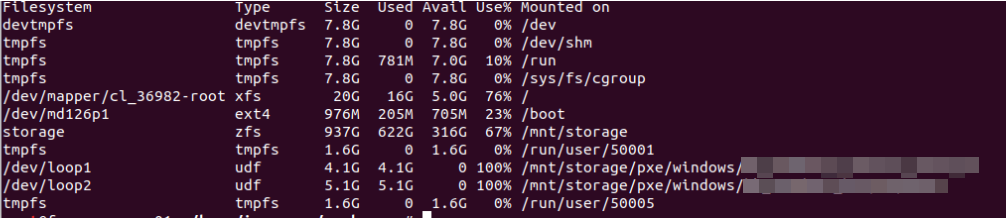
The default configuration of Node Exporter displays all available file systems:

You should ignore such file systems as tmpfs, autofs, udf, iso9660, etc., because otherwise the monitoring system will flood you with a large number of alerts that do not contain any actionable information, and thus significantly reduce your efficiency when monitoring server hardware.

This problem can be easily solved by adding the collector.filesystem.ignored-fs-types parameter to the exporter configuration.

By default, $NODE_EXPORTER_OPTS is loaded from a file:
# /etc/default/node_exporter

We add:

NODE_EXPORTER_OPTS="--collector.filesystem.ignored-fs-types="^(tmpfs|autofs|udf|iso9660)$""

After restarting the exporter, the parameters will no longer be displayed, so the metric will not be taken into account. This approach can significantly reduce the resources consumed by the monitoring system and simplify the equipment management procedure as a whole, as well as facilitate the work of your engineers.

Rent dedicated and virtual servers with instant deployment in reliable TIER III class data centers in the Netherlands and the USA. Free protection against DDoS attacks included, and your server will be ready for work in as little as 15 minutes. 24/7 Customer Support.

Other articles

23.04.2026

Server Price Increases in 2026: Forecasts, Causes, and Recommendations

The server market is heating up again: memory prices are rising by tens of percent, GPUs are in short supply, and cloud providers are preparing to raise rates. We break down what's happening in 2026 and how to avoid overpaying.

21.04.2026

Why No One Remembers What Was Decided After an Hour-Long Call

An hour in Zoom passes with no action items. This isn't a fluke: video calls have specific cognitive limits that poor organization only exacerbates. We break down why this happens and which simple changes actually work.

17.04.2026

Putting "Legacy" V100s to Work with Modern AI Agents for Documentation

Documentation becomes outdated faster than code. We solved this with AI agents and V100 GPUs. It works, but not without nuances.

17.04.2026

WordPress with OpenLiteSpeed vs Classic LEMP: Real Benchmarks

OpenLiteSpeed outpaces LEMP dramatically: up to 10x more RPS and 35x lower TTFB. But it crashes at 500 concurrent connections. Tested on real servers with load tests.

20.03.2026

Launching an Internet Radio Station with AzuraCast

Internet radio hasn't disappeared; it has simply migrated to the cloud. This guide demonstrates how to launch your own radio station on a VPS with AzuraCast in just 15 minutes: upload music, configure live streaming, connect a domain, and obtain an API for integrations.

Upload